
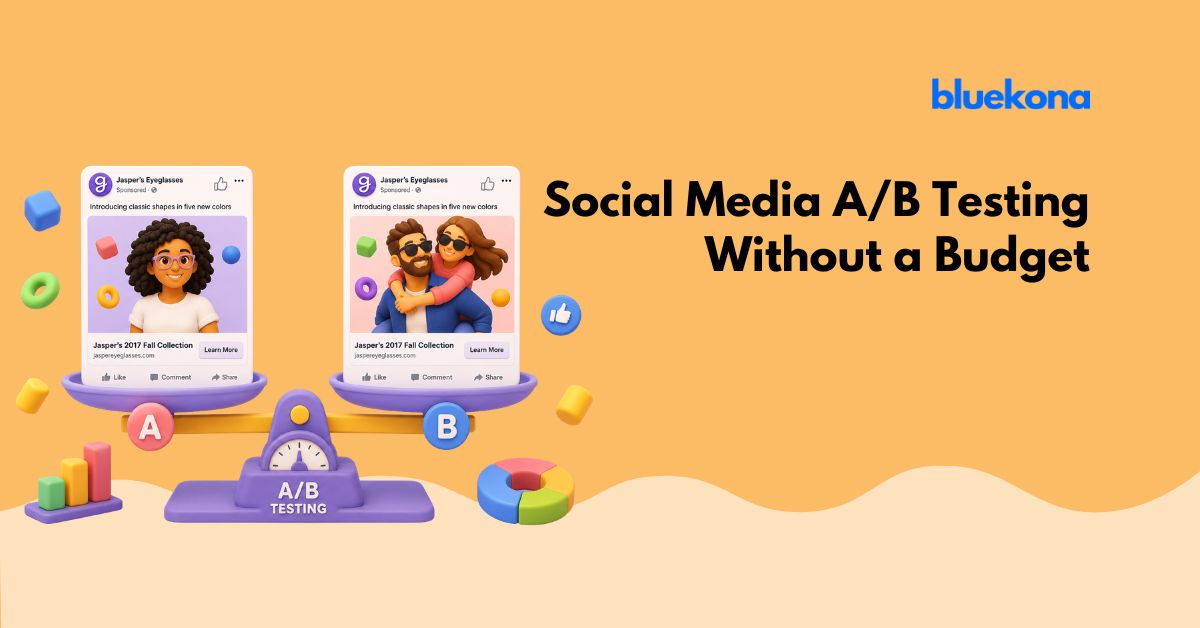
Social Media A/B Testing Without a Budget: How to Run Organic Content Experiments That Actually Teach You Something
Most teams assume A/B testing belongs in the paid ads world. And honestly, that assumption makes sense. Paid gives you a clean split. Two versions, two audience groups, one clear winner. Organic social does not work that way. You cannot divide your audience. You cannot post two versions at the same time and measure them side by side.
So most content teams skip experiments entirely and go with gut feel instead.
That is where growth stalls.
You do not need a paid budget to run meaningful content experiments. You need a system. And right now, most of your competitors are running without one. They post, check the numbers, feel okay or a little disappointed, and move on. No written hypothesis. No experiment log. Nothing changes next time because of what happened last time.
This guide walks you through a practical framework for running organic social media A/B tests that give you real, repeatable lessons. Not hunches. Actual insights that compound into a content advantage over time.
Why Most Organic Teams Never Actually Learn
The irony of social media is that you are already swimming in data. Every platform gives you reach, impressions, saves, shares, watch time, and click-through rate. You are not short on numbers.
What most teams are short on is a structure for turning those numbers into conclusions.
When you post a video, check the views, notice it did well, and try to “do more of that” next week without understanding what specifically worked, you are not learning. You are hoping the same unknowable combination of factors lines up again on its own.
Real learning needs a before-and-after comparison where only one thing changed. Without that, every result is ambiguous. Your Reel got 80% more reach this week. Was it the hook? The format? The audio? The fact that you posted on a Wednesday instead of Monday? The algorithm having a generous day?
You will never know. And that is the whole problem. Check out our article on the problem with social media metrics to understand why this blind spot costs most teams more than they realise.
The One Rule That Makes or Breaks Every Experiment
Change exactly one thing at a time.
That is the whole rule. Everything else in your testing process builds on this single idea.
If you change your hook, your format, your posting time, and your caption length all in the same post, and that post performs well, you have a data point but no lesson. You cannot untangle what drove the result. You are right back to guessing.
The discipline of organic A/B testing is picking one variable, keeping everything else the same, and comparing the results over a consistent time window. It feels slow. It is the only method that actually tells you what is working and why.

Changing your hook, your format, your caption length and your posting time in the same test is not an experiment. That is just chaos with a content calendar.
What to Test First (and What to Leave for Later)
Not all variables are worth your time equally. Some have a massive impact on whether your content gets seen at all. Others are marginal adjustments. Here is where to focus first, and what to come back to once you have the big stuff dialled in.
Start Here
Hook or Opening Line
The first sentence of your caption, the first frame of your video, or the headline on a static post. This is the highest-leverage variable across almost every platform. A weak hook kills reach before the algorithm has a chance to push the content anywhere.
Start Here
Content Format
Carousel versus single image versus Reel versus text post. Format sends a major signal to platform algorithms and shapes how your audience consumes and shares content. Test the same topic in different formats to isolate what the format itself is contributing to your results.
Next
Call to Action Wording
The specific words and placement of your CTA drive comments, saves, and shares, which all feed the algorithm. Small wording changes produce surprisingly large differences. Test “Save this for later” against “Which tip was most useful to you?” and you will likely see a real gap.
Next
Posting Time and Day
When your audience is online and in what mindset matters more than most people think. Test the same content type at different times to find your actual peak windows, not the generic “best times to post” guides that have nothing to do with your specific audience.
Later
Caption Length
Short and punchy versus long-form and contextual. Platform and audience both shape which performs better. The only way to know what your specific audience prefers is to test it directly on your own account, not by following generic platform advice.
Later
Thumbnail or Cover Image
On YouTube and TikTok especially, the cover frame or thumbnail determines whether anyone clicks or watches in the first place. If video is your primary format, move this variable higher on your testing list. It is one of the most direct levers for improving click-through rate.
How to Run the Experiment Step by Step
Here is the process that separates teams who accumulate real content knowledge from teams who are still guessing after two years of posting.
1
Write a hypothesis before you post anything. Do not reverse-engineer a story after the results come in. Write it down first. Something like “I believe a question-based hook will generate more comments than a statement hook on our LinkedIn posts about analytics, because it prompts the reader to give a direct response.” This forces clarity and makes your results actually interpretable.
2
Create two versions of the post and change only one variable. Write Version A and Version B. Keep the topic, format, visual style, posting time, and hashtags identical. The only thing that changes is your test variable. If you are testing hooks, the rest of the caption must stay exactly the same in both versions.
3
Post them in the same week on different days. Post Version A on Tuesday, then Version B on the following Tuesday. Same time of day, same platform, same week of the month. You cannot post both simultaneously on organic, so this staggered approach is your best approximation of a controlled comparison.
4
Measure the right metric for the variable you are testing. Match your measurement to your test. Testing a CTA? Measure comments and saves. Testing a hook? Measure early reach and the percentage of people who watched past the first three seconds. Testing format? Look at shares and profile visits. Using one vanity metric for everything will give you misleading conclusions.
5
Log the result as a win, a loss, or inconclusive. Keep a simple experiment log. Record what you tested, the hypothesis, the result for each version, and your conclusion. A basic spreadsheet works. The log is the real asset here. It is what turns a collection of individual tests into compounding institutional knowledge about your audience.
6
Run the same test at least three times before drawing conclusions. One test is a data point. Three tests are a pattern. If question-based hooks outperform statement hooks in three out of three tests, you have a finding worth acting on. If results split two to one, keep testing. Do not build strategy on a single result.
Which Metrics to Track on Each Platform
One of the most common testing mistakes is measuring the wrong thing. A post can have high reach and zero engagement. Another can have low reach and very high saves. Which one won? It depends entirely on what you were testing for.
Match your measurement to your variable every single time. Here is a quick breakdown of which metrics signal real performance on each platform, as opposed to the vanity numbers that look good but tell you nothing useful.
On Instagram, saves and shares carry the most algorithmic weight. Reach from people who do not follow you yet is a signal that the algorithm is actively pushing your content beyond your existing base. Likes are the weakest indicator by far and should be the last thing you optimise for.
On LinkedIn, comments and reposts are what drive reach. Impressions from outside your network tell you the content is breaking through into new audiences. Reactions matter far less than the volume and quality of comments you generate. See our breakdown of LinkedIn content strategy for more context on what the algorithm rewards.
On TikTok, watch time percentage and rewatch rate are the metrics that matter most. A high view count with low average watch time means people are clicking away fast. That is a negative signal regardless of how impressive the raw number looks in your dashboard.
On YouTube, click-through rate on your thumbnail and title combined with average view duration explains most of your algorithmic performance. High CTR with low view duration is a signal your title over-promised what the video actually delivered.
On Facebook, shares and link clicks matter most for organic reach. Track your organic reach per post as a percentage of your total follower count. If that ratio is shrinking month over month, your content is losing relevance with the algorithm. Our guide on Facebook metrics that actually matter in 2026 goes deeper on this.
On Threads, replies and quote posts are the strongest signals. Reshares tell you people found the content worth amplifying to their own networks. Like counts on Threads are almost meaningless as a performance indicator and should be ignored when evaluating your tests. And if you want to understand how dwell time quietly shapes your reach, that applies across all of these platforms too.
Likes are the participation trophy of social media. Nice to receive. They will not tell you a single useful thing about whether your content is actually working.

Building a Quarterly Learning Loop
Individual tests are useful. A system of tests over time is a growth engine.
The difference is compounding. Each experiment builds on the last. After a quarter of structured testing, you stop asking “what should we post this week?” and start asking “based on what we already know works, what should we test next?” That shift changes how your whole content operation runs.
Here is a simple quarterly loop that works for SMBs and agencies of any size.
In Month 1, run four to six hook experiments on your two most active platforms. By the end of the month you should know with real confidence which hook styles drive the most early engagement for your specific audience, not for someone else’s audience in a different niche.
In Month 2, run four to six format experiments, applying your winning hook style from Month 1. You are now stacking knowledge. You have already optimised the opening line. Now you are testing what structure and format perform best on top of that foundation. See our piece on why manual audits waste your time for how automation can accelerate this part of the process.
In Month 3, test CTA wording and posting time. By this point your content is already stronger from two rounds of experiments. The smaller optimisations compound on a better base and produce a bigger result than they would have at the start.
At the end of the quarter, review your experiment log and write a short summary of what you found. This becomes your actual content strategy for the next quarter. Not a mood board. Not a trend report. An evidence-based plan built entirely on what you know works for your audience.
Mistakes That Make Your Tests Useless
Testing too many variables at once. Already mentioned, worth repeating one more time. One variable per test. Every single time. No exceptions.
Pulling results too early. Organic content needs time to distribute and find its audience. Do not compare a two-day-old post to a seven-day-old post. Set a consistent measurement window of five to seven days and apply it to every experiment you run, every time.
Treating outliers as strategy. A post that goes semi-viral will skew your data. Note it in your log, celebrate it, and then set it aside when drawing conclusions. Do not rebuild your entire content approach around one anomaly that you may never be able to replicate.
Missing the external context. A post that underperforms during a major news cycle or platform outage is not failing because of your content. Log what was happening alongside your results. That context becomes important when you review your data later and need to explain why a particular test week looks different from the rest.
Comparing across different audience sizes. If your account grew significantly between Version A and Version B, you are not running a fair comparison. You are measuring two different audience pools. Flag large growth jumps in your experiment log and treat those results with appropriate caution.
The Compounding Advantage
Most of your competitors are not doing this.
They are posting based on what worked for someone else, in a different niche, with a different audience, six months ago. They are copying trending formats without checking whether those formats actually convert for their specific followers. And when something underperforms, they shrug and move on without a single lesson to show for it.
When you have six months of structured organic experiments behind you, you have something no competitor can copy. Tested, validated knowledge about what works for your audience, on your platforms, in your category. Because every experiment builds on the last, the knowledge gap between you and teams that are still guessing keeps getting wider every single week.
The brands that win on organic social over the long term are not always the ones with the biggest teams or the most creative instincts. They are the ones who learn faster. Structured A/B testing on organic content is exactly how you build that learning advantage, without spending a cent on ads. If you want to see how this applies to a specific brand playbook, our breakdown of scaling social media strategy with AI is a good place to go next.
Your competitors are still posting on vibes. You are posting on evidence. That is not a small edge. That is the whole game.
Bluekona AI gives you cross-platform analytics, automated content audits, and actionable insights across every platform in one place, so your experiment log practically writes itself.