
How to Scale Your Social Media Strategy Without Scaling Your Team
Most marketers aren’t running out of ideas — they’re running out of time. Between managing three content calendars, replying to comments, and chasing the latest algorithm shift, “doing social media” starts to feel like a full-time job for five people.
That’s where AI changes the game. Not as a replacement, but as a force multiplier.
With the right systems — and more importantly, the right prompts — AI can help you audit, repurpose, and optimize your content faster than most agencies can write a brief. The difference between average results and real growth?
The strategy behind what you ask it to do.
This guide breaks down proven AI prompt frameworks that help you scale awareness, engagement, and conversions — without adding a single new hire.
Awareness Prompts — How to Get More Eyes on Your Content
If your reach has stalled or impressions are dropping, AI can help you uncover what your audience actually responds to — and show you how to recreate that success across platforms.
These prompts turn your analytics tab into your creative brief. You’ll stop guessing what went viral and start reverse-engineering it with data.
The goal here? Maximize reach and impressions. Stop guessing why that one post blew up and start reverse-engineering success.
1. Social Media Insights Strategist
What it does: Analyzes your top-performing content and generates new post ideas based on what’s actually driving impressions.
Why you need this: Ever feel like you’re just throwing content at the wall to see what sticks? This prompt turns your analytics into a creative brief, so you can stop guessing and start replicating what actually works. Think of it as reverse-engineering your wins — but without the spreadsheet headache.
You are a Social Media Insights Strategist specializing in content performance analytics.
Using the last 90 days of data for [brand] on [platform] (attached as csv), your task is to summarize the post types and content pillars driving the highest reach and views. Then, based on these insights, generate 5 new post angles that mirror those high-performing drivers.
Each new post idea should include the following:
Angle: The strategic perspective or narrative direction of the post
Format: The ideal content type (e.g., Reel, carousel, infographic, story, etc.)
Hook: A short, scroll-stopping opening line or idea
Reason (linked to metric): A rationale connecting the idea to the reach or views metric
Visual Idea: A specific creative or visual concept for execution
Present your analysis and recommendations in a clean table format for easy comparison
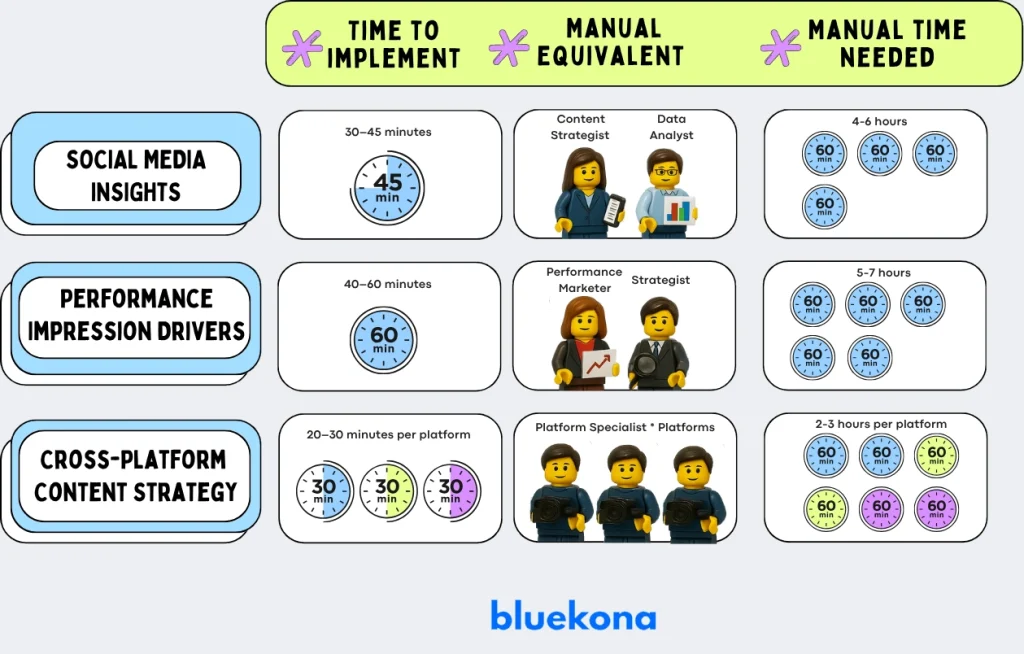
- Time to implement: 30–45 minutes
- AI Power Level: 7/10 — great for pattern recognition and ideation
- Manual equivalent: Content strategist + data analyst (4–6 hours)
2. Performance Analyst for Impression Drivers
What it does: Identifies what drives impressions and reverse-engineers hooks that work.
Why you need this: Your analytics are trying to tell you something, but they’re speaking in numbers instead of English. This prompt translates “30K impressions” into “here are 10 hooks that’ll perform just as well” — so you can replicate success without reinventing the wheel every Monday morning.
Prompt
You are a Social Media Performance Analyst.
Using the last 50 posts from [platform] (attached as csv), your task is to identify the top impression drivers — including topic, format, and duration — that contributed most to awareness (reach and impressions/views).
Then, based on these insights, create 10 scroll-stopping hooks (each under 8 words) that mirror the most successful content patterns.
Ensure the hooks align with:
- The content style of [content type] posts
- The tone of [tone] messaging
- The engagement behaviors specific to [platform] users
Present the results in two clear sections:
- Top Impression Drivers Summary (table format: “Driver Type | Example | Impact on Reach”)
- 10 Scroll-Stopping Hooks (numbered list under 8 words each)
- Time to implement: 40–60 minutes
- AI Power Level: 8/10 — excellent for diagnostic analysis
- Manual equivalent: Performance marketer + strategist (5–7 hours)
3. Cross-Platform Content Strategist
What it does: Takes your best content and adapts it for TikTok, Reels, LinkedIn, or wherever else you’re trying to show up.
Why you need this: You posted something that killed on Instagram and now you’re wondering if it’ll work on LinkedIn (spoiler: not without tweaking). This prompt handles the translation work so you’re not just copy-pasting the same content everywhere and praying. AI becomes your platform-native translator.
Prompt:
You are a Cross-Platform Content Strategist skilled at adapting high-performing content to native formats.
Using the highest-reaching post from [date range], your task is to repurpose it for multiple social platforms — specifically: Instagram Reels, TikTok, LinkedIn Document, X Thread, and Facebook Post.
Follow these rules:
- Maintain the original insight or storytelling essence.
- Adapt each piece to fit platform tone, length, and format expectations (e.g., punchy for Reels/TikTok, narrative for LinkedIn, conversational for X).
- Include hooks, hashtags, and CTAs aligned with each platform’s best practices.
Present your answer in this format:
| Platform | Native Format | Hook/Opening Line | Adapted Copy | Length Guidance | Best Practice Tip |Conclude with a short paragraph on how this repurposing approach sustains audience engagement while increasing overall cross-platform visibility.
- Time to implement: 20–30 minutes per platform
- AI Power Level: 7/10 — solid for repurposing, though you’ll want to add your brand voice
- Manual equivalent: Platform specialist (2–3 hours per adaptation)
These prompts can turn your analytics into your creative brief. You’ll stop wondering why something went viral and start to systematically recreate the conditions for it to happen again.
Engagement Prompts — How to Turn Scrollers Into Community
Awareness gets you seen. Engagement gets you remembered.
Likes are easy. Conversations are valuable. AI can help you uncover why people interact — and build repeatable frameworks for content that sparks comments, saves, and shares.
These prompts turn passive audiences into active communities — the kind that talks back, not just scrolls past.
AI can diagnose engagement drops and tell you what to fix.
4. Data-Led Creative Strategist
What it does: Diagnoses engagement drops and tells you what to fix.
Why you need this: Your engagement rate is tanking and you’re not sure if it’s the algorithm, your content, or Mercury in retrograde. This prompt plays detective with your data and gives you actual fixes to test — not just vague advice like “post more consistently.” It’s like having a strategist on call, minus the retainer fee.
Prompt:
You are a Data-Led Creative Strategist.
Our engagement rate by reach declined from [x%] to [y%] in [month].
Your mission is to perform a diagnostic analysis of performance trends, considering:
- Content mix: Topic balance, storytelling depth, and audience fit.
- Format split: Type ratios (Reels, carousels, static posts, etc.).
- Cadence: Frequency, timing, and audience fatigue indicators.
Then, create an actionable output containing:
- 3 Hypotheses: Root cause theories supported by pattern recognition or typical social metrics.
- 3 Fixes per Hypothesis: Practical recommendations for optimization.
- 2 Test Posts per Hypothesis: Specific content concepts designed to validate your assumptions.
Tabulate everything in a structured layout:
Hypothesis | Underlying Cause | Fix #1 | Fix #2 | Fix #3 | Test Post #1 | Test Post #2 |Ensure your recommendations reflect best practices for [platform] and focus on rebuilding engagement velocity through creative iteration.
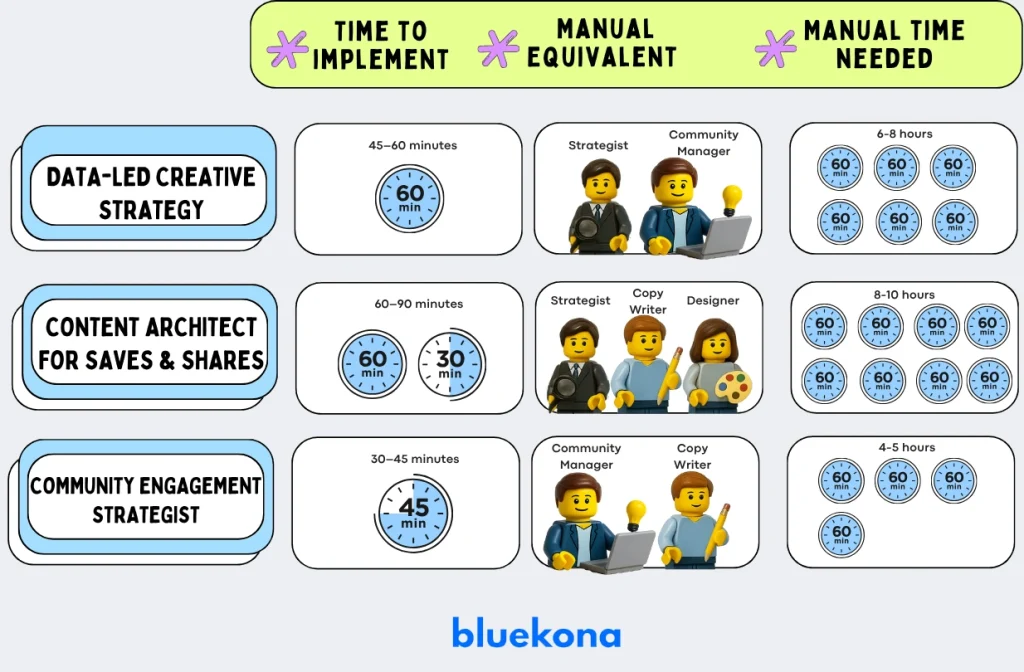
- Time to implement: 45–60 minutes
- AI Power Level: 8/10 — strong diagnostic reasoning
- Manual equivalent: Strategist + community manager (6–8 hours of analysis)
5. Content Architect for Saves & Shares
What it does: Creates saveable, shareable content frameworks that people actually want to keep.
Why you need this: You want to create those posts people bookmark for later, not just like and scroll past. This prompt analyzes what makes content “save-worthy” and builds you templates that are actually useful — the kind of stuff your audience will reference next week, not forget in five minutes.
Prompt:
You are a Data-Led Content Architect for [brand].
Review the top-performing posts by saves and shares from [date range], and analyze what made them successful by identifying:
- Topic Patterns: Which themes consistently drove saves/shares.
- Structural Traits: Layout, headline flow, and visual rhythm.
- Length Patterns: Carousel size, caption brevity, or clip duration.
- Visual Approach: Aesthetic consistency or standout visual cues.
Using those insights, design:
- 3 Saveable Carousel Outlines: Educational or tool-style posts that encourage repeat reference.
- 3 Shareable Post Frameworks: Emotionally resonant or value-forward content made to spread organically.
Each outline or framework should contain:
| Type | Theme/Angle | Content Flow or Slide Plan | Visual/Design Idea | Suggested CTA |End with a brief summary on how to test these concepts for performance validation (e.g., A/B content split by visual style or caption length).
- Time to implement: 60–90 minutes (including design time)
- AI Power Level: 8/10 — excellent at structure, though design execution is still on you
- Manual equivalent: Strategist + copywriter + designer (8–10 hours)
6. Community Engagement Strategist
What it does: Generates comment-bait questions and conversation starters that actually work.
Why you need this: Getting likes is easy. Getting people to actually talk to you? That’s the hard part. This prompt studies what makes your audience comment and creates questions that spark real conversations — not just “tag a friend” spam that makes everyone roll their eyes.
Prompt:
You are a Community Engagement Strategist.
Analyze the top comment threads from our posts to identify recurring audience themes and emotional triggers that drive conversation.
Based on those insights, generate 20 questions that will have comments from audience — a mix of:
- Open-ended prompts (invite storytelling or opinions)
- This-or-that questions (encourage quick interaction)
- Hot takes (provoke debate respectfully)
Each question should align with one of our content pillars — [list pillars or use placeholders like Pillar A, Pillar B, etc.].
Output format:
| Question Type | Comment-Bait Question | Linked Content Pillar | Engagement Intent (Story / Debate / Reaction) |Ensure the tone fits [brand tone or audience type], and write each question to be scroll-stopping yet authentic, sparking curiosity and dialogue.
- Time to implement: 30–45 minutes
- AI Power Level: 7/10 — great for variety, needs your brand voice layered in
- Manual equivalent: Community manager + copywriter (4–5 hours)
These prompts don’t just increase engagement — they help you understand what triggers conversation. It’s like running a mini focus group without leaving your desk.
Conversion Prompts — How to Turn Content Into Clicks
Awareness builds reach. Engagement builds trust.
But conversions? That’s where the ROI actually lives.
This is where most social strategies fall flat — because turning attention into action requires more than great content. It requires precision messaging.
AI can help you sharpen every caption, link, and call-to-action so your content doesn’t just perform — it converts.
Use these prompts to transform engagement into measurable business results.
Generates CTAs that actually convert based on your audience.
7. Conversion Copy Strategist
What it does: Generates CTAs that actually convert based on your audience and offer.
Why you need this: You’re tired of writing “link in bio” like it’s 2017 and hoping for the best. This prompt creates CTAs with actual psychology behind them — from soft nudges to hard sells — so you can test what gets clicks without sounding like a used car salesman.
Prompt:
You are a Conversion Copy Strategist specializing in high-performing social media CTAs.
Using insights from our top conversion posts on [platform], generate 10 CTA variations tailored for [offer/landing page].
For each CTA:
- Include a Short Caption Version (under 15 words) and a Long Caption Version (2–3 sentences).
- Add UTM guidance showing how to tag campaign source, medium, and content (e.g., ?utm_source=[platform]&utm_medium=social&utm_campaign=[offer_name]).
- If applicable, include a compliant disclosure line (e.g., “Affiliate link. I may earn a small commission.”).
Output format:
| # | CTA Theme | Short Version | Long Version | UTM Tag Example | Disclosure (if needed) |Ensure each CTA:
- Matches the tone and best practices of [platform].
- Reflects proven tactics from past high-converting posts (e.g., urgency, scarcity, social proof).
- Encourages immediate action in an authentic, brand-aligned voice.
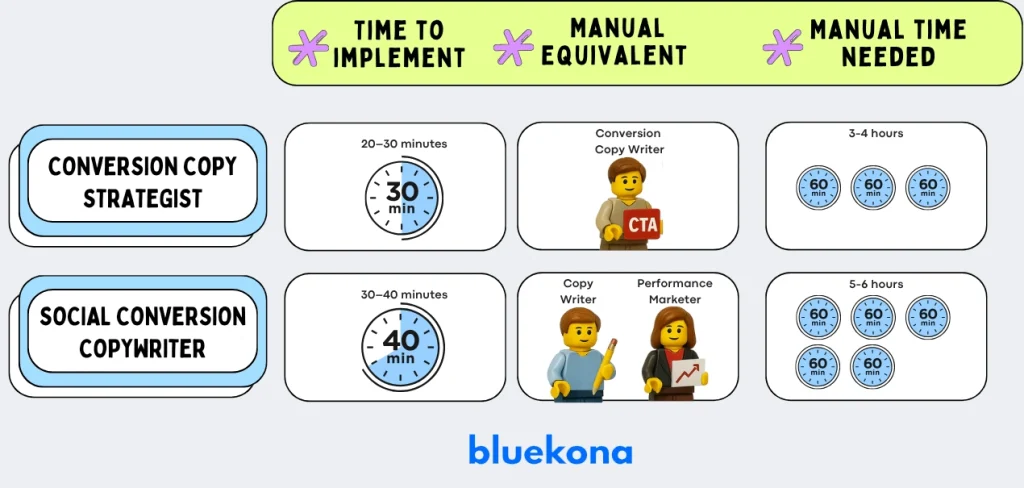
- Time to implement: 20–30 minutes
- AI Power Level: 9/10 — highly repeatable and data-friendly
- Manual equivalent: Conversion copywriter (3–4 hours)
8. Social Conversion Copywriter
What it does: Writes link copy that drives clicks and helps you track what’s working with UTM parameters.
Why you need this: You need clicks, not just engagement. This prompt writes platform-native link copy that doesn’t sound desperate or salesy, plus it handles the UTM tracking setup so you actually know which post drove that spike in traffic. Finally, attribution you can trust.
Prompt:
You are a Social Conversion Copywriter skilled in crafting human, high-converting link copy.
Your task is to write 10 link copy variations optimized for [platform], promoting [offer or landing page].
Each link copy should:
- Front-load the value (why the user should click immediately).
- Sound authentic and natural, avoiding overly salesy tones.
- Include a UTM-tagged link formatted as ?utm_source=[platform]&utm_medium=social&utm_campaign=[offer_name]&utm_content=[variant_label].
- Specify where the link appears — e.g., Bio, First Comment, or Card/End Screen.
Output format:
| # | Link Placement | Copy (Human-Tone) | UTM Link Example | Primary Value Hook |Ensure each variation fits [platform]’s style conventions (e.g., conversational for TikTok, concise for X, professional for LinkedIn).
- Time to implement: 30–40 minutes
- AI Power Level: 9/10 — excellent at structure and tracking logic
- Manual equivalent: Copywriter + performance marketer (5–6 hours)
Let’s be real, AI can’t close your sale. But it can absolutely triple your click-through rate if you feed it real insights instead of generic copy templates.
Platform-Specific Prompts
Every social platform rewards different behavior — and your AI prompts should reflect that.
Copy-pasting the same content across channels doesn’t scale your brand. It just multiplies mediocrity.
Use platform-specific AI instructions to go beyond “post more” and start creating strategically.
These prompts help you tailor your message to each algorithm’s language — maximizing visibility, engagement, and conversion potential.
Use these prompts to balance creative polish with performance data.
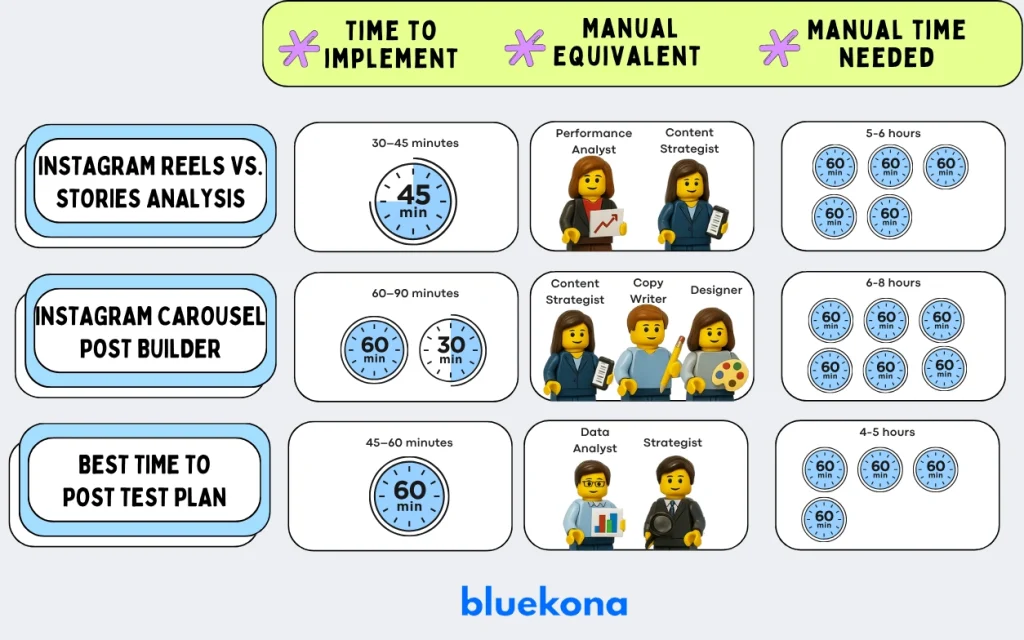
Reels vs. Stories Performance Analysis
Why you need this: You’re splitting time between Reels and Stories but have no idea which one’s actually moving the needle. This prompt analyzes your data and tells you where to invest your energy — complete with ready-to-use post briefs. It’s like having a performance analyst who actually speaks creator.
You are an Instagram Content Performance Strategist.
Using insights from the past 60 days of Reels vs. Stories data, analyze performance patterns to recommend the best-performing format choices for achieving [goal] (e.g., awareness, engagement, conversions).
Then, create 6 post briefs, each including:
- Format: Reel or Story (plus sub-format like tutorial, trend, testimonial, etc.)
- Hook: Scroll-stopping intro idea
- First 2 Lines: What appears on screen or in caption immediately
- Suggested Length: Ideal runtime or frame count
- Reason (linked to metric): Explain why this format supports the goal, grounded in performance data (e.g., retention rate, completion percentage, interaction rate).
Output in a clean table format:
| # | Format | Hook | First 2 Lines | Suggested Length | Reason (Linked to Metric) |Keep your tone insightful, creative, and platform-native, reflecting Instagram’s evolving engagement trends (e.g., shorter Reels outperforming longer ones, conversational Stories boosting reply rate).
- Time: 30–45 minutes
- AI Power: 8/10
- Manual equivalent: Performance analyst + content strategist (3–4 hours)
Carousel Post Builder
Why you need this: Carousels are engagement gold, but creating 10 slides that people actually swipe through? That’s a Saturday afternoon you’ll never get back. This prompt identifies your best-performing themes and builds complete carousel outlines — slides, visuals, CTAs, the works. You just add the design.
You are an Instagram Content Strategist specializing in performance analytics and engagement optimization.
Using data from the past 90 days of Instagram content, identify the top-performing content pillars (themes driving the most saves and shares).
Then, create 4 carousel post outlines (10 slides each) that build on those high-performing themes.
Each carousel should include:
- Slide Titles (1–10): Clear, engaging headline per slide
- Imagery Suggestions: Photo, illustration, graphic, or text-based visual ideas
- Mid-Carousel CTA (Slide 5–6): A compelling action prompt (e.g., “Save this for later,” “Tag a friend,” “Swipe for the checklist”)
Ensure each outline is designed to maximize saves and shares through value-based storytelling (education, insight, emotional resonance, or listicle-style).
Present the output in a structured table:
| Carousel # | Theme (Pillar) | Slide Titles (1–10) | Imagery Ideas | Mid-Carousel CTA | Why It Drives Saves/Shares |
- Time: 60–90 minutes
- AI Power: 8/10
- Manual equivalent: Content strategist + designer + copywriter (6–8 hours)
Best Time to Post Test Plan
Why you need this: Everyone says “post when your audience is active” but your engagement data looks like a crime scene. This prompt creates an actual test plan with days, times, formats, and success metrics — so you can finally figure out when your people are actually scrolling.
You are an Instagram Performance Analyst.
Using our hourly engagement data from the past 90 days (attached as csv), design a 2-week best-time-to-post test plan for Instagram.
Your plan should include:
- Days to Post: Which weekdays/weekends to prioritize.
- Times to Post: Optimal hours based on historic engagement peaks.
- Formats: Reel, Story, Carousel, or Static Image (with rationale).
- Posts per Day: Recommended posting frequency for accurate testing.
- Success Criteria: How to measure improvement using Engagement Rate by Reach (ER/R).
Output the test plan in a table format:
| Day | Time (Local) | Format | # of Posts | Objective | Success Metric (ER/R Target) |Then, include a summary section titled “Testing Logic” that explains:
- How posting times were chosen (data peaks).
- How to compare results week-over-week.
- The threshold for declaring a statistically meaningful improvement in ER/R.
- Time: 45–60 minutes
- AI Power: 7/10
- Manual equivalent: Data analyst + strategist (4–5 hours)
TikTok
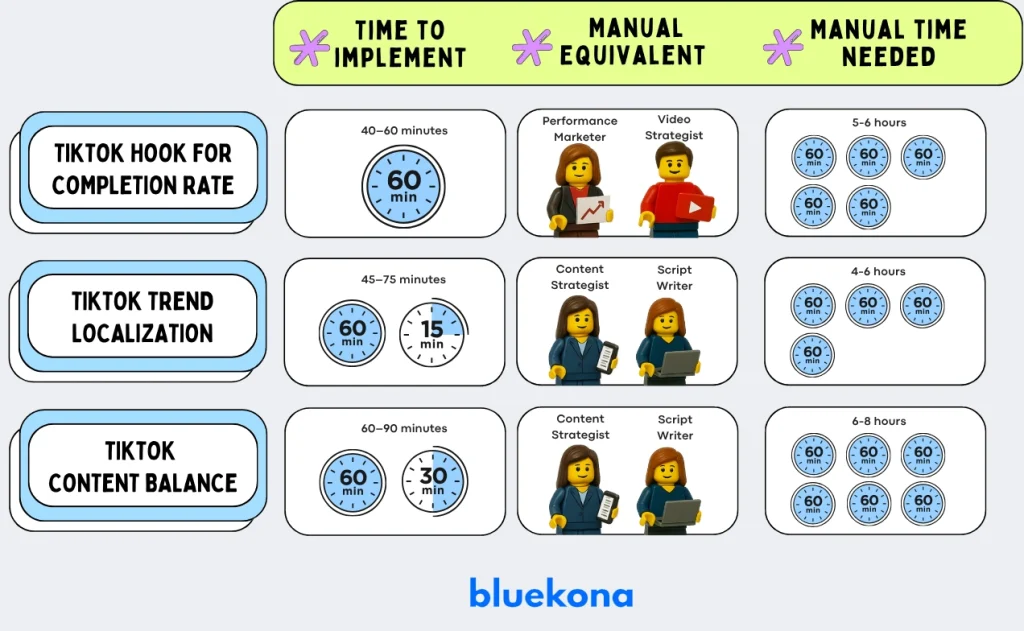
Hook Generator for Completion Rate
Why you need this: On TikTok, you’ve got 3 seconds before someone swipes away — and you’re running out of ways to say “wait for it.” This prompt analyzes your retention data and creates hooks designed to keep people watching. More completion = more distribution. Simple math.
You are a TikTok Performance Strategist specializing in short-form video optimization.
Analyze the last 20 TikToks to identify:
- Hook Patterns: Phrases, visuals, or pacing elements used in the first 3 seconds.
- Completion Rate Trends: Average percentage of viewers who finished each video.
- Average Watch Time: Key retention benchmarks.
Using those insights, generate 12 new 10-second hook variations specifically designed to increase completion rate by 15%.
Each hook should include:
- Hook Line (≤10 seconds)
- Format Type: Talking head, POV, text overlay, trend remix, etc.
- Emotional Driver: Curiosity, FOMO, humor, controversy, or authority.
- Reason (Linked to Metric): Explain how it supports retention or watch time.
Present the output in a table:
| # | Hook Line | Format Type | Emotional Driver | Reason (Linked to Metric) |Keep the tone platform-native, conversational, and optimized for immediate scroll-stopping impact in the first 1–3 seconds.
- Time: 40–60 minutes
- AI Power: 8/10
- Manual equivalent: Performance marketer + video strategist (5–6 hours)
Trend Localization Scripts
Why you need this: You see a trending format and think “this could work for us” — but by the time you figure out how to adapt it, the trend’s already dead. This prompt takes any trend and creates niche-specific scripts that feel authentic, not forced. Jump on trends without losing your brand voice.
You are a TikTok Trend Strategist.
Your task is to localize [trend] for our [niche] by analyzing competitor execution patterns (tone, structure, pacing, visuals).
Using those insights, create 5 original TikTok scripts, each designed to fit the trending format while authentically reflecting our niche.
Each script should include:
- Opening Hook (first 2–3 seconds): Must stop the scroll and reference the trend naturally.
- 3 Beat Points: Key story or content moments that deliver the message.
- Niche Insight Callout: Tie the trend directly to our niche’s value, pain point, or humor.
- CTA: Platform-native call-to-action (e.g., “Comment if you’ve seen this too,” “Follow for more insider tips”).
Output in a clean table:
| Script # | Opening Hook | Beat Point 1 | Beat Point 2 | Beat Point 3 | Niche Insight | CTA |Keep tone authentic, fast-paced, and visually aligned with the trending TikTok format.
- Time: 45–75 minutes
- AI Power: 7/10
- Manual equivalent: Content strategist + scriptwriter (4–6 hours)
Educational vs. Entertainment Balance
Why you need this: Your TikTok strategy is either “teach everything” or “dance and hope for virality” with no middle ground. This prompt creates scripts for both educational and entertainment content, so you can test what your audience actually wants — saves or shares, credibility or reach.
You are a TikTok Content Strategist.
Your task is to draft six total TikTok scripts — three educational and three entertainment-focused — centered on [topic].
For each script, include:
- Format Type: Educational or Entertainment
- Script: 3-beat structure (hook, body, payoff)
- Expected Engagement Difference: How it will perform (e.g., higher saves for educational, more shares/comments for entertainment)
- Ideal Length: Duration in seconds (based on watch time trends)
- On-Screen Text Plan: Overlay text for each beat (hook emphasis, value line, CTA text)
Output in this format:
| # | Format Type | Hook | Body (Beats 1–3) | Expected Engagement Difference | Ideal Length (sec) | On-Screen Text Plan |Keep tone platform-native, concise, and authentic, using real-world TikTok pacing and voiceover flow.
- Time: 60–90 minutes
- AI Power: 7/10
- Manual equivalent: Scriptwriter + content strategist (6–8 hours)
Your brand’s authority lives or dies by the quality of insight you share. AI can help you turn raw data or ideas into relatable leadership narratives.
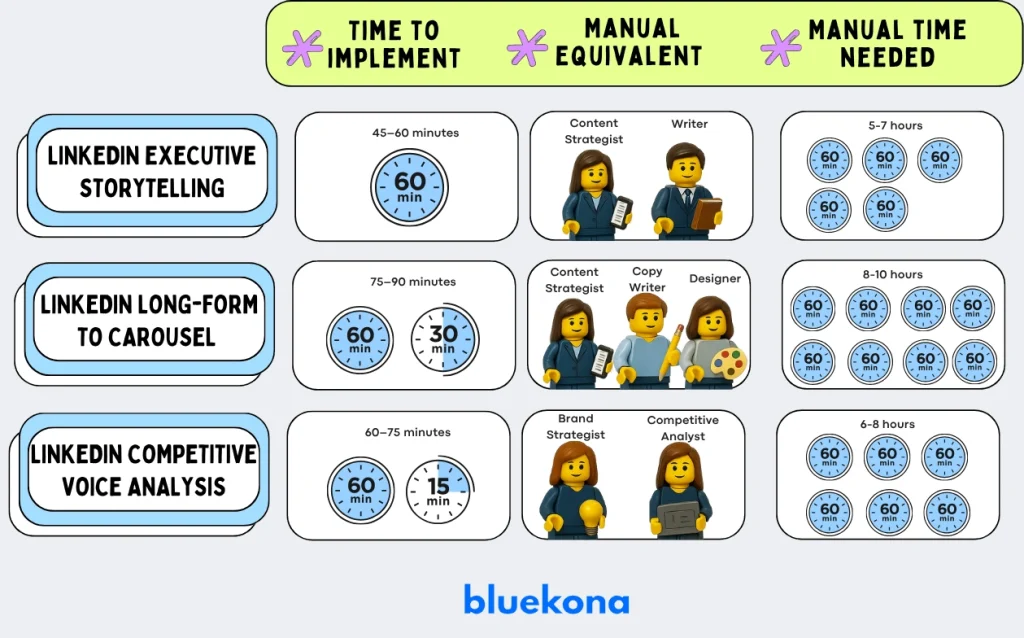
Executive Storytelling from Data
Why you need this: LinkedIn loves a good stat, but nobody wants another “X% of businesses are doing Y” snooze-fest. This prompt turns industry data into executive-level insights that sound smart without being boring. You’ll look like a thought leader, not a press release bot.
You are a LinkedIn Executive Storytelling Expert.
Take [industry stat or report insight] and turn it into 5 C-level point-of-view posts that translate data into leadership insight.
Each post should follow this logic:
- Headline Line: Attention-grabbing, forward-looking insight (max 15 words).
- Supporting Claim: Data or trend summary from the original insight.
- Leadership Take: What this means for the future — decisions, culture, strategy, or innovation.
- Discreet CTA: Soft engagement driver, like “Curious to hear how your team is preparing.”
Output format:
| # | Headline Line | Supporting Claim | Leadership Take | CTA (Soft Prompt) |Conclude with a short section titled “LinkedIn Leadership Content Guidance” — summarizing best practices for formatting (line spacing, emoji usage, post length) and emotional tone (balanced between authoritative and human).
- Time: 45–60 minutes
- AI Power: 8/10
- Manual equivalent: Executive ghostwriter + strategist (5–7 hours)
Long-Form to Carousel Adapter
Why you need this: You spent weeks on that whitepaper and now it’s collecting digital dust. This prompt repurposes long-form content into LinkedIn carousels and document posts that people will actually read (and save). Turn your content graveyard into engagement gold.
You are a LinkedIn Content Strategist specializing in turning long-form thought leadership into engaging carousel and document posts.
Using [long-form asset] (e.g., a report, whitepaper, blog, or presentation), create:
- 2 LinkedIn Carousels
- 1 LinkedIn Document Post
For each asset, provide:
- Hook (Click-to-Open Line): A scroll-stopping, curiosity-driven headline.
- Slide-by-Slide Outline: 8–10 slides per carousel/doc post, summarizing each key point.
- Data Highlights: Stats, quotes, or visuals that make the content more shareable.
- Tone & CTA Recommendation: Voice alignment with brand and platform-appropriate CTA (e.g., “Save this for your next strategy review”).
Output format:
| Asset Type | Hook / Opening Line | Slide 1–10 Outline | Data Highlights | CTA Suggestion |Ensure content is:
- Value-forward: Present insights before the ask.
- Visually structured: Each slide should have one clear message.
- Native to LinkedIn: Professional but conversational, using whitespace and accessible phrasing.
- Time: 75–90 minutes
- AI Power: 8/10
- Manual equivalent: Content strategist + designer + copywriter (8–10 hours)
Competitive Voice Analysis
Why you need this: You’re posting on LinkedIn but so are your competitors — and you’re starting to sound the same. This prompt analyzes their voice, finds the gaps, and shows you where to differentiate. Stop blending in and start owning your unique perspective.
You are a LinkedIn Brand Strategist.
Your task is to analyze and compare our brand voice with [3 competitors] across the following dimensions:
- Tone & Voice Style (e.g., formal vs. conversational)
- Topic Focus (themes, thought leadership areas, trending discussions)
- Content Cadence (posting frequency, content mix, and engagement rhythm).
From this analysis, identify 5 content gaps — unique opportunities where our brand can lead and differentiate.
For each gap, provide:
- Gap Description: What competitors are missing or underleveraging.
- Opportunity Rationale: Why this matters to our audience and aligns with brand positioning.
- Sample Post: A short LinkedIn post (headline + 2–3 sentences + discreet CTA).
Output format:
| # | Content Gap Description | Opportunity Rationale | Sample LinkedIn Post (Mini-Draft) |End with a section titled “Strategic Voice Alignment”, summarizing how our tone and cadence can evolve to stand out while maintaining brand authenticity.
- Time: 60–75 minutes
- AI Power: 7/10
- Manual equivalent: Brand strategist + competitive analyst (6–8 hours)
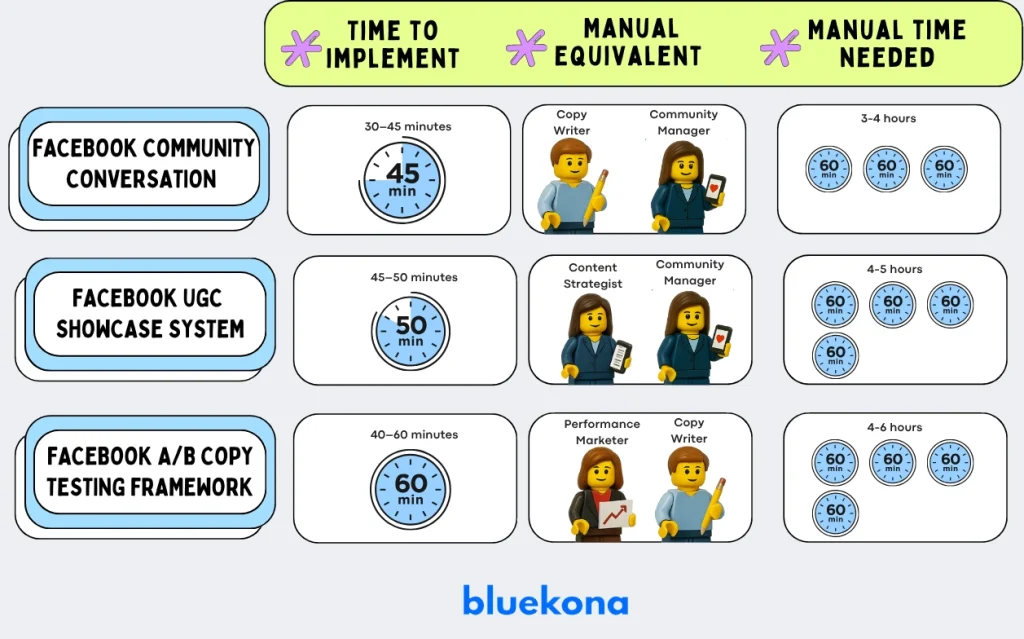
Community Conversation Starters
Why you need this: Facebook engagement is a ghost town and you’re not sure if anyone’s even seeing your posts anymore. This prompt studies what made people comment before and creates conversation starters that actually get replies. Resurrect your Facebook community from the dead.
You are a Facebook Community Strategist.
Using engagement insights from our top 10 Facebook posts in the last 90 days, identify the content patterns and triggers that drove the highest comments and shares (e.g., tone, topic type, emotional appeal, question framing).
Then, based on these learnings, create 10 new conversation-starter post ideas tailored for [community].
Each post should include:
- Opening Line / Hook: Emotionally resonant or curiosity-driven.
- Prompt or Question: Designed to spark replies and discussion.
- Engagement Intent: Whether it aims to drive comments, shares, or both.
- Reason (Linked to Past Performance): Why this approach will work (data-driven rationale).
Output format:
| # | Post Hook / Opening Line | Prompt or Question | Engagement Intent | Reason (Linked to Past Top-10 Post Patterns) |Keep the tone authentic, inclusive, and conversational — encouraging storytelling, opinions, or humor native to Facebook community dynamics.
- Time: 30–45 minutes
- AI Power: 7/10
- Manual equivalent: Community manager + copywriter (3–4 hours)
UGC Showcase System
Why you need this: Your community is creating content about you, but you’re not doing anything with it. This prompt turns user submissions into engaging showcase posts that make your members feel famous — and inspire more people to participate. It’s a content loop that basically runs itself.
You are a UGC Content Repurposing Expert.
Analyze the latest User-Generated Content submitted by members of [community].
Your task: turn 5 of these into Facebook community posts that both highlight members and motivate more to participate.Each post must include:
- Headline: Eye-catching and emotional.
- Short Copy: Context about the UGC — story, moment, or quote.
- Credit Format: Consistent brand format for acknowledging creators.
- CTA: Conversational invitation for others to share, comment, or tag the page.
Present your plan in this format:
| # | Headline | Short Copy | Credit Format | CTA (Community Submission Prompt) |Conclude with a short section titled “Content Loop Strategy”, describing how to build a repeating cycle of UGC → showcase → community participation → new submissions for continuous engagement growth.
- Time: 45–60 minutes
- AI Power: 7/10
- Manual equivalent: Content strategist + community manager (4–5 hours)
A/B Copy Testing Framework
Why you need this: That post format that used to crush? It’s not working anymore, and you don’t know why. This prompt sets up proper A/B tests with real hypotheses and success metrics — so you can figure out what’s broken and fix it, instead of just posting harder.
You are a Facebook Content Strategist tasked with reviving a declining post format (e.g., quotes, polls, carousels, or videos).
Develop 6 A/B copy tests designed to re-engage the audience and identify which tone, structure, or CTA drives higher interaction.
Each test should include:
- Hypothesis: What you’re testing (e.g., emotional vs. informative tone, long vs. short copy).
- Variant A (Control): Current or baseline copy style.
- Variant B (Test): Revised or experimental version.
- Success Metric: What defines improvement (e.g., comment-to-reach ratio, share-to-reach ratio, 3-second views).
Present in this format:
| Test # | Hypothesis | Variant A (Control Copy) | Variant B (Test Copy) | Success Metric / Goal |Keep both variants short, conversational, and native to Facebook, using natural phrasing and community-oriented tone.
- Time: 40–60 minutes
- AI Power: 8/10
- Manual equivalent: Performance marketer + copywriter (4–6 hours)
X (Twitter)
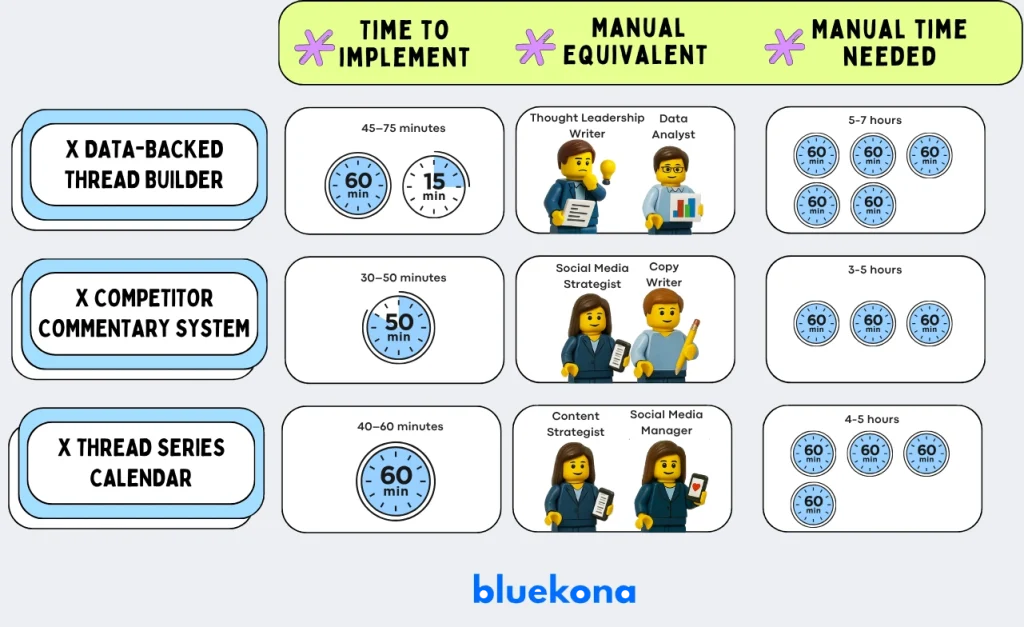
Data-Backed Thread Builder
Why you need this: You want to build authority on X, but your threads either sound like everyone else’s or die after three tweets. This prompt structures viral-worthy threads around real data and contrarian takes — the kind that get quoted, not just liked and forgotten.
You are a Thought Leadership Architect creating viral, data-backed threads to establish expertise on [topic].
Craft 3 thread outlines, each structured around:
- A Data Insight or Stat: Foundation for credibility.
- A Contrarian Take: Challenges conventional thinking.
- A Practical Lesson or Takeaway: Actionable insight for professionals.
Each thread should include:
- Opening Tweet (Hook): A bold statement or question using data.
- Supporting Data & Benchmarks (2–3 tweets): Use stats to build context.
- Contrarian Insight (1–2 tweets): Reframe the narrative.
- Takeaway (1–2 tweets): What readers can apply or learn.
- CTA: Conversation or follow-up action.
Deliver in a structured table:
| Thread # | Hook Tweet | Key Stats / Benchmarks | Contrarian Insight | Takeaway Summary | CTA |End with a short section titled “Thread Optimization Notes”, covering best practices for pacing (line breaks, tweet length, use of visuals, emoji moderation).
- Time: 45–75 minutes
- AI Power: 8/10
- Manual equivalent: Thought leadership writer + data analyst (5–7 hours)
Competitor Commentary System
Why you need this: Your competitors are winning and you want to join the conversation without sounding bitter or copycat-y. This prompt creates smart, additive commentary that piggybacks on their success while positioning you as the thoughtful alternative. Strategic, not salty.
You are an Industry Voice Architect crafting smart, nuanced commentary for X.
Analyze competitor wins (top-performing posts, campaigns, or partnerships) and create 10 tweet ideas that respond with fresh, additive perspective rather than critique.
Each tweet should:
- Reference the Trend or Moment: Acknowledge what others are celebrating.
- Add Insight: Introduce a data point, future forecast, or missing nuance.
- Offer Value: Turn the moment into a learning or strategic takeaway.
- Stay Constructive: Maintain a tone of professional admiration and informed curiosity.
Deliver in this format:
| Tweet # | Hook / Opening Line | Additive Insight or Contrarian Angle | Key Takeaway (What Readers Learn) | Tone Style |End with a section titled “Engagement Strategy”, explaining how to use these tweets to spark respectful discussion — e.g., “Curious who’s next to try this?” or “This changes how I think about [X].”
- Time: 30–50 minutes
- AI Power: 7/10
- Manual equivalent: Social media strategist + copywriter (3–5 hours)
Thread Series Calendar
Why you need this: You know threads work, but posting them randomly isn’t building momentum. This prompt maps out a strategic thread series timed to your best engagement windows — so each thread builds on the last and keeps people coming back for more.
You are a X (Twitter) Growth Strategist.
Your task is to plan a 4-part thread series on [topic or theme], strategically aligned with our optimal posting windows (based on engagement data).
For each thread, include:
- Working Title: Attention-grabbing and curiosity-led.
- Posting Day & Time: Aligned to our best engagement hours.
- Key Focus: Core idea or insight per thread.
- Expected Metric to Watch: Engagement type that signals success (e.g., likes for relevance, replies for discourse, saves for value, follows for authority).
Output format:
| Thread # | Working Title | Posting Day / Time | Key Focus / Summary | Primary Metric to Watch |End with a section titled “Cadence Strategy” explaining how to space threads (e.g., one every 3 days, 9 a.m. local time) and how each thread should build upon or tease the next to sustain momentum and anticipation.
- Time: 40–60 minutes
- AI Power: 7/10
- Manual equivalent: Content strategist + social media manager (4–5 hours)
YouTube
Title & Thumbnail CTR Optimizer
Why you need this: Your video content is solid, but nobody’s clicking because your titles and thumbnails are doing you dirty. This prompt analyzes what drove clicks in the past and creates title-thumbnail combos designed for maximum CTR — no clickbait required.
You are a Data-Led YouTube Strategist.
Analyze our past CTR and retention data, and create 10 high-performing title ideas and 5 thumbnail text candidates for the next video on .
Each title and thumbnail should:
- Reflect proven click triggers (data-backed phrasing like “How to…”, “What Happens When…”, or “The Truth About…”).
- Avoid clickbait — instead, promise specific insight or payoff.
- Be supported by reasoning tied to audience psychology or historical metrics.
Deliver in two sections:
Title Ideas Table:
| # | Proposed Title | CTR Pattern Applied | Rationale (Linked to Past Data) |Thumbnail Text Table:
| # | Text (2–5 Words) | Emotional Angle / Design Suggestion | CTR Reasoning |Finish with a short section titled “Optimization Guidance”, explaining how to A/B test the top 3 title–thumbnail pairings and which engagement metrics (CTR, average view duration, watch percentage) should determine the winner.
- Time: 45–60 minutes
- AI Power: 8/10
- Manual equivalent: YouTube strategist + designer + copywriter (5–7 hours)
Retention-Focused Intro Script
Why you need this: People click your videos, then bounce at the 15-second mark. This prompt writes intros that hook viewers immediately and give them a reason to stay — problem, promise, credibility, all in 30 seconds. Your watch time will thank you.
You are a YouTube Retention Strategist.
Your task is to write an intro script (0–30 seconds) for a video on [topic], structured to maximize audience retention by combining storytelling, clarity, and pacing.
The intro must include:
- Problem Setup: Define the core pain point or curiosity gap in the viewer’s mind.
- Promise / Payoff: What viewers will gain or learn by watching till the end.
- Credibility Cue: Why you’re qualified to speak on it (social proof, results, or experience).
- Chapter Tease: A single line previewing the structure (“Here’s how we’ll break it down…”).
Deliver output in this format:
| Section | Script (0–30s) | Purpose / Retention Mechanism |Tone: conversational, confident, and audience-first. Keep pacing brisk, with one idea per sentence.
- Time: 20–30 minutes
- AI Power: 8/10
- Manual equivalent: Video scriptwriter + retention specialist (2–3 hours)
Long-Form to Shorts Repurposing
Why you need this: You spent hours on a long-form video and now you need Shorts to promote it — but creating 6 different clips sounds like torture. This prompt identifies the best moments, writes hooks, and gives you edit directions. One video becomes six pieces of content.
You are a YouTube Shorts Strategist.
Your task is to repurpose a [long-form video] into 6 Shorts, each optimized for strong hooks, punchy edits, and a consistent branded end card line.
Each Short should include:
- Hook (0–3s): Captures attention instantly with curiosity, contrast, or emotion.
- Key Moment / Core Message (4–40s): The most shareable or insightful moment from the long-form video.
- Edit Direction: Notes on pacing, cuts, captions, and music tone.
- Branded End Card Line: A short, consistent brand sign-off (e.g., “Follow for smarter growth in 60 seconds.”).
Output format:
| Short # | Hook (0–3s) | Key Moment / Message | Edit Direction | End Card Line |End with a section titled “Performance Layering Strategy” summarizing how to distribute the Shorts (cadence, titles, hashtags) to maximize discoverability and drive back to the original long-form video.
- Time: 60–90 minute
- AI Power: 7/10
- Manual equivalent: Video editor + content strategist + copywriter (6–8 hours)
Pro tip: If your team only has bandwidth for one platform, start here. These prompts double as micro playbooks you can adapt as you scale.
From Prompts to Performance: The bluekona Way
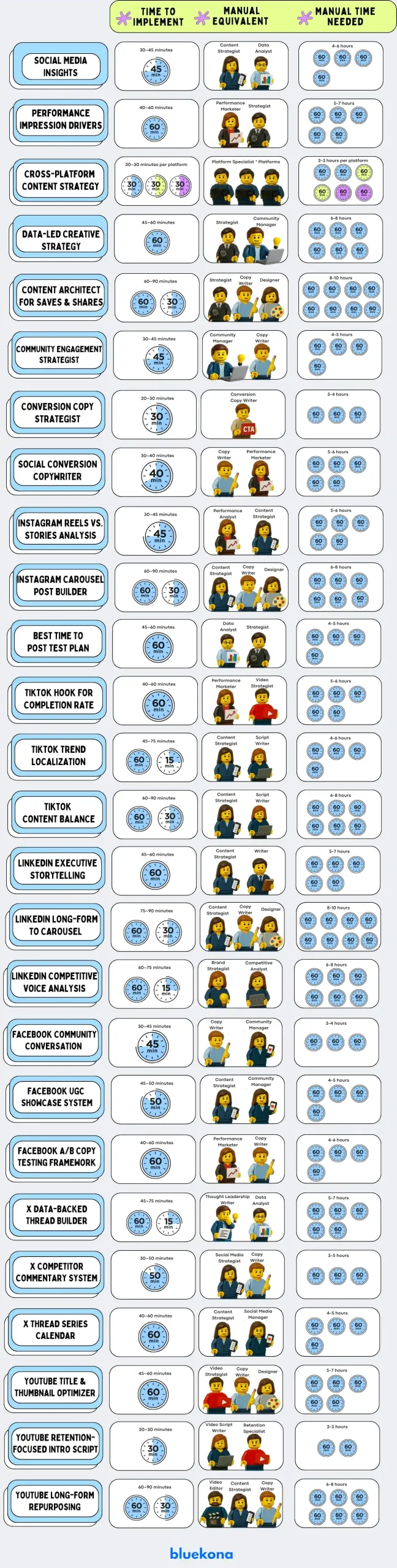
Okay, so now you’ve got prompts for days. You could copy-paste these every week, feed your analytics in manually, and keep playing the ChatGPT game.
Or you could let bluekona automate the whole thing.
Because here’s what nobody tells you about AI prompts: they work great… once. But doing them consistently? That’s the real bottleneck. You end up with a Google Doc full of “prompts