
Facebook metrics that actually matter in 2026
Here’s something most marketing teams won’t say out loud: Facebook still works. Not in the same way it did in 2015, and not for every business, but it works. Billions of people still open the app every day. Ads still convert. Pages still drive real traffic. The platform is not dying.
So why do so many teams feel like they are getting nothing from it?
The answer is not Facebook. It is the way most teams think about what success looks like on Facebook. There is a quiet assumption baked into a lot of marketing conversations that if a platform feels old or unsexy, the results must be bad. And when results feel bad, the instinct is to blame the channel.
But here is what the data actually shows: most teams are not failing because Facebook stopped working. They are failing because they are measuring the wrong things and making decisions based on those numbers. Their dashboards are full of activity. What they do not have is clarity.
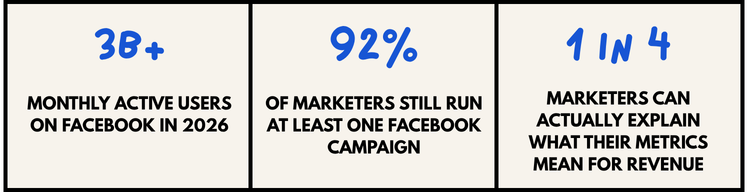
Platforms do not die. Bad strategy does. And bad strategy almost always starts with bad measurement.
If you are running Facebook as part of your marketing mix and it feels like you are spinning your wheels, the first question to ask is not “should we still be on Facebook?” The first question is “do we actually know what we are measuring and why?”

Most teams, if they are honest, do not.
The Real Problem With Facebook Metrics
Open up Facebook Ads Manager or Meta Business Suite and you will find dozens of numbers staring back at you. Reach, impressions, frequency, CPM, CPC, CTR, engagement rate, video views, 3-second views, 10-second views, post reactions, shares, comments, link clicks, landing page views, cost per result, relevance score, and on and on.
Every single one of those numbers is real. Some of them matter a lot. Most of them, for most goals, do not matter at all.
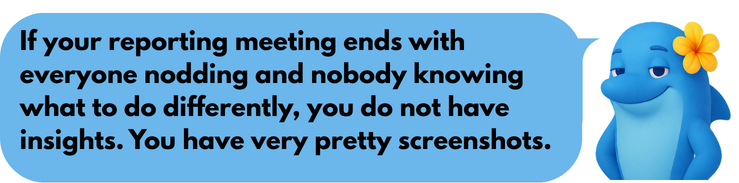
The problem is not that the data does not exist. The problem is that having a lot of data and understanding what to do with it are two completely different things. Most marketing teams have built reporting habits where they screenshot numbers into a slide deck, present them on a call, and everyone nods. Nobody asks the hard question: based on this, what should we do differently?
That disconnect, between reporting and actual decision-making, is where most social media budgets quietly leak out.
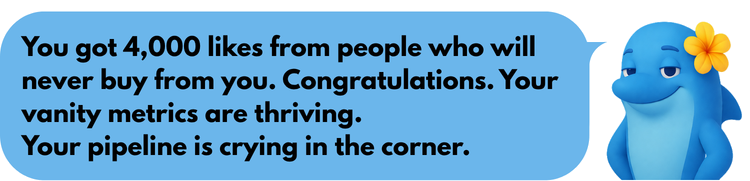
Vanity metrics are the biggest culprit. A post that gets 4,000 likes sounds great until you realize those likes came from people who would never buy your product. A campaign with impressive reach numbers looks good in a report until someone asks why revenue did not move. Impressions tell you that an ad was served. They do not tell you that it worked.
Data is not the problem. Interpretation is. And interpretation requires having a framework, a clear idea of what you are actually trying to achieve and which numbers connect to that goal. Without that framework, you are just collecting numbers.
Most teams have no framework. They measure everything and understand nothing. And the more metrics they add, the less clear the picture gets.
The Only Facebook Metrics That Actually Matter
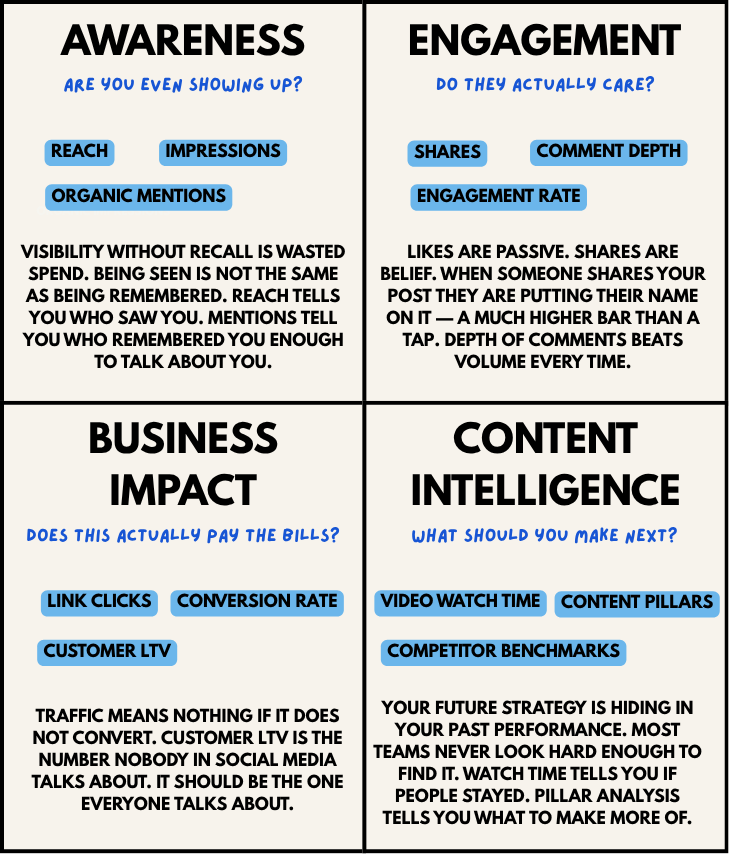
Not every metric deserves your attention. Here are the four categories that actually connect to outcomes, and what to look at inside each one.
Awareness Metrics: Are You Even Visible?
Before anything else, people need to see you. That sounds obvious, but a lot of teams skip over awareness metrics because they feel soft, like they are not tied to money. They are wrong.
Reach tells you how many unique people saw your content. This is different from impressions, which counts total views including the same person seeing the same post multiple times. Reach gives you the real number of individuals your message actually got in front of.
Impressions tell you how often your content appeared in front of people. A high impression count with low reach means a small group of people is seeing you over and over. That can be a sign your targeting is too narrow, or that you are burning out the same audience.
Mentions show up when people talk about your brand without being prompted. Organic mentions are a signal that something you did or said actually stuck. They are rare and worth tracking because they indicate real awareness, not just ad delivery.
Here is the thing about visibility though: being seen is not the same as being remembered. If your content is getting reach but no engagement, no clicks, no follows, you are visible but forgettable. Visibility without recall is wasted effort. Awareness metrics should not be the end of the story. They should be the start.
Engagement Metrics: Do People Actually Care?
Engagement is where things get tricky, because not all engagement is equal.
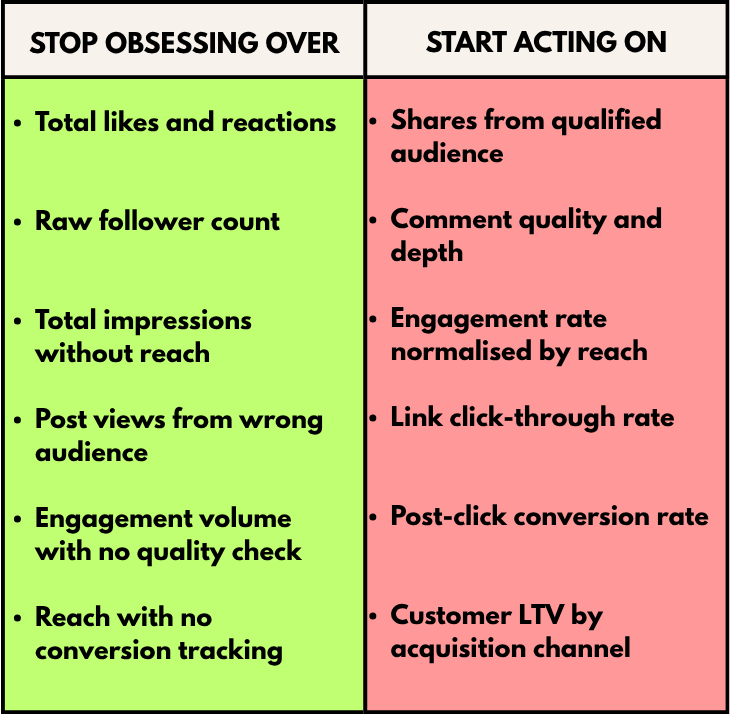
Likes are the lowest form of engagement. They take one tap and they mean almost nothing. Someone liking a post is not the same as someone caring about your brand. It is a passive gesture. Do not optimize for likes.
Comments are more meaningful, but the quality matters more than the count. Ten thoughtful comments from your ideal customers are worth more than a hundred one-word replies. When you read your comments, ask yourself: are these from people who look like buyers? Are they asking questions, sharing opinions, engaging with what you actually said? Depth of conversation beats volume of noise every time.
Shares are the strongest engagement signal on Facebook. When someone shares your post, they are putting their name on it. They are saying “this is good enough that I want my friends and followers to see it.” That is a much higher bar than a like. If your content is being shared consistently, that tells you something important about what is resonating.
Engagement rate combines all interactions relative to reach or followers. It is a better benchmark than raw numbers because it gives you a rate, not just a count. A post that gets 200 engagements from 2,000 people is performing better than a post that gets 300 engagements from 30,000. Engagement rate normalizes for audience size.
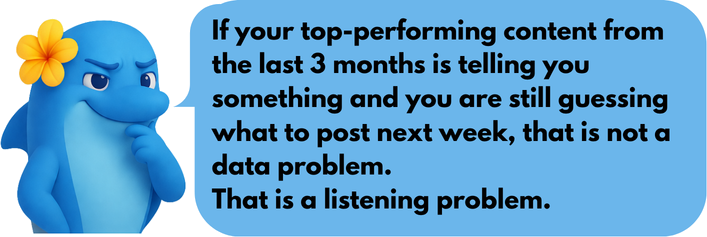
The mistake most teams make is chasing total engagement numbers. What you should be chasing is engagement from the right people. High engagement from an audience that does not convert is a feel-good metric that does not move your business.
Performance and Business Impact Metrics: Does Any of This Drive Revenue?
This is where most Facebook measurement breaks down, and it is the most important category.
Link clicks tell you how many people cared enough to leave Facebook and go somewhere you control. This is one of the clearest signals of real interest. If someone clicks a link, they did not just scroll past your content. They took a deliberate action. Track this number carefully and always ask: out of everyone who saw this, what percentage clicked? A low click-through rate on a broadly targeted post might be fine. A low click-through rate on a retargeting campaign aimed at warm leads is a problem.
Conversion rate is the number that ties everything back to business reality. Of all the people who clicked through, how many did the thing you wanted them to do? Bought something, signed up, booked a call, whatever your goal is. Traffic without conversion is not marketing. It is just burning budget.
This is the gap that most social media teams fall into. They optimize for clicks and celebrate when traffic numbers go up. But if the conversion rate is low, more traffic just means more people arriving and leaving without doing anything. The issue might be the ad, but it might also be the landing page, the offer, the audience targeting, or the timing. Conversion rate forces you to look at the whole picture.
Customer Lifetime Value is the number that almost nobody in social media talks about, and it is possibly the most important one. If you acquire a customer through Facebook and they spend significantly more over their lifetime than the average customer from another channel, your Facebook investment is paying off in ways that short-term ROAS numbers will never capture. If Facebook tends to bring in low-value customers who churn quickly, that is also something you need to know.
Traffic means nothing if it does not convert. And conversion data only tells part of the story if you are not tracking what happens after the first purchase.
Content Intelligence Metrics: What Should You Do More Of?
The fourth category is often completely ignored. It should not be. Your past performance on Facebook is one of the best roadmaps you have for your future strategy.
Video watch time is a signal that tells you whether the thing you made was worth watching. Not whether people hit play, whether they kept watching. Short watch times on a long video tell you the opening was not strong enough. High average watch percentages tell you the content genuinely held attention. Facebook rewards content that keeps people on the platform, which means watch time data is doubly useful: it tells you what your audience wants and it tells you what the algorithm will prioritize.
Content pillars are the broad themes your content falls into. When you look at your top-performing posts over the past three months, what do they have in common? Are behind-the-scenes posts getting more traction than product posts? Are educational pieces outperforming promotional ones? This kind of analysis tells you what your audience actually wants from you on Facebook, which is often different from what you think they want or what you want to say.
Competitor benchmarks give you context. Your engagement rate means nothing in isolation. Is it high or low for your industry? Your reach growth might feel slow until you see that your competitors are flat. Context does not change your numbers, but it completely changes how you should interpret them.
Your future content strategy is hidden inside your past performance data. Most teams never look hard enough to find it.
The Missing Layer: Where Most Teams Actually Fail
Here is something that almost never gets said in social media conversations: most teams are decent at tracking metrics. They are terrible at turning metrics into decisions.
Think about this scenario. You have a campaign with strong reach. Lots of impressions. Decent engagement. And then you look at conversions and the number is low. What do you do next?
Most teams write “reach was good, conversions were low” in their report and move on. That is not insight. That is description.
What you need is a layer of thinking that connects the numbers to a specific action. High reach with low conversions tells you one of several things: your targeting is too broad and you are reaching people who are not your customer, your creative is grabbing attention but not communicating value, your offer is not compelling enough, or your landing page is breaking the experience. Each of those diagnoses leads to a different fix. But you can only get there if someone is asking the question.
Here is another scenario. High engagement, lots of comments and shares, great response in the comments section, and then you look at who is engaging and realize it is not your target customer at all. Your posts are resonating with an audience that will never buy from you. What do you do?
Again, most teams celebrate the engagement and move on. But the right question is: why are we attracting the wrong audience, and how do we adjust targeting or messaging to shift that?
The gap between metrics and action is where most marketing budgets disappear. Teams have the data. They do not have the habit of asking what the data means and what it should change.
This is the hardest skill to build in a social media team and the most valuable one. Anyone can pull a report. Very few people can look at a set of numbers and say “here is what this tells us and here is exactly what we should do differently this week.”
The 3-step framework: metrics to decisions to outcomes
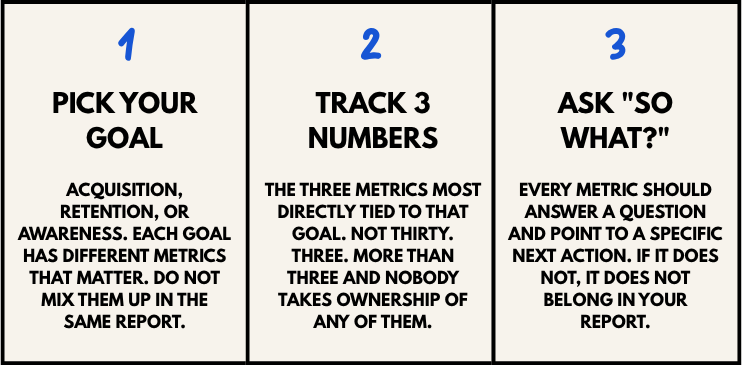
The best social media teams are not the ones with the most data. They are the ones who know exactly what their data is telling them and what to do about it. Here is the simplest version of that habit.
Where Bluekona Fits In
Most analytics tools give you more data. That is not always what you need.
What most teams are missing is not more numbers. It is a system that takes the numbers they already have and turns them into clear, specific actions. Something that tells you: this content is working, do more of it. This campaign is underperforming against your goal, here is why. This audience segment is showing strong conversion signals, prioritize it.
That is what Bluekona is built to do. It is not another dashboard. It is a layer that sits between your metrics and your decisions, and it does the translation work that most teams either skip or do badly.
Bluekona identifies which metrics actually matter given your specific goal. If your current objective is acquisition, it weights conversion data differently than if your objective is brand awareness. It connects engagement signals to business outcomes so a spike in shares does not just get celebrated but gets analyzed: who shared it, did those shares drive traffic, did that traffic convert?
It also surfaces what content to double down on based on actual performance patterns, not just the most recent post or the one that got the most likes. And it flags what is not working before you have spent another month running a campaign that is not going to deliver.
The core idea is simple: instead of tracking everything and understanding nothing, you track what matters, understand what it means, and know what to do next.
That is the loop most teams are missing. Metrics, decisions, execution. Not metrics, report, repeat.
Key Takeaways
Facebook is not dead. Billions of people use it every day and it still drives real business outcomes for brands that use it well.
Most measurement frameworks are dead though. They were built for a version of social media where reach and likes were enough to show value, and they have not caught up with what actually matters now.
The metrics that drive decisions are reach, engagement quality, conversion rate, and content performance patterns. Everything else is noise unless you can draw a direct line from that number to a business outcome.
Engagement does not equal growth. A post can go viral with entirely the wrong audience. Strong engagement from people who will never buy from you is not a win. It is a misdirection.
And clarity always beats dashboards. A team that tracks six metrics with real understanding of what each one means will outperform a team drowning in forty metrics they do not know how to use.
Start Here
If you are tracking everything but understanding nothing, it is time to step back and rebuild from the metrics that actually connect to your goals.
Stop measuring more. Start measuring what matters.
Pick one goal. Find the three metrics that most directly tell you whether you are hitting it. Build your reporting around those three numbers. When you have a clear picture of what is working and what is not, then you can layer in more complexity.
The best social media teams are not the ones with the most data. They are the ones who know exactly what their data is telling them and what to do about it.
TL;DR
Remember these 5 things
- Facebook is not dead. Billions of people use it every day and it still drives real business outcomes for brands that use it well.
- Most measurement frameworks are dead. They were built for a version of social media where reach and likes were enough to show value.
- Metrics only matter if they drive decisions. Reporting without action is just describing what happened.
- Engagement does not equal growth unless it converts. Strong engagement from people who will never buy is a misdirection, not a win.
- Clarity beats dashboards. Six metrics you understand deeply will always outperform forty you do not.