
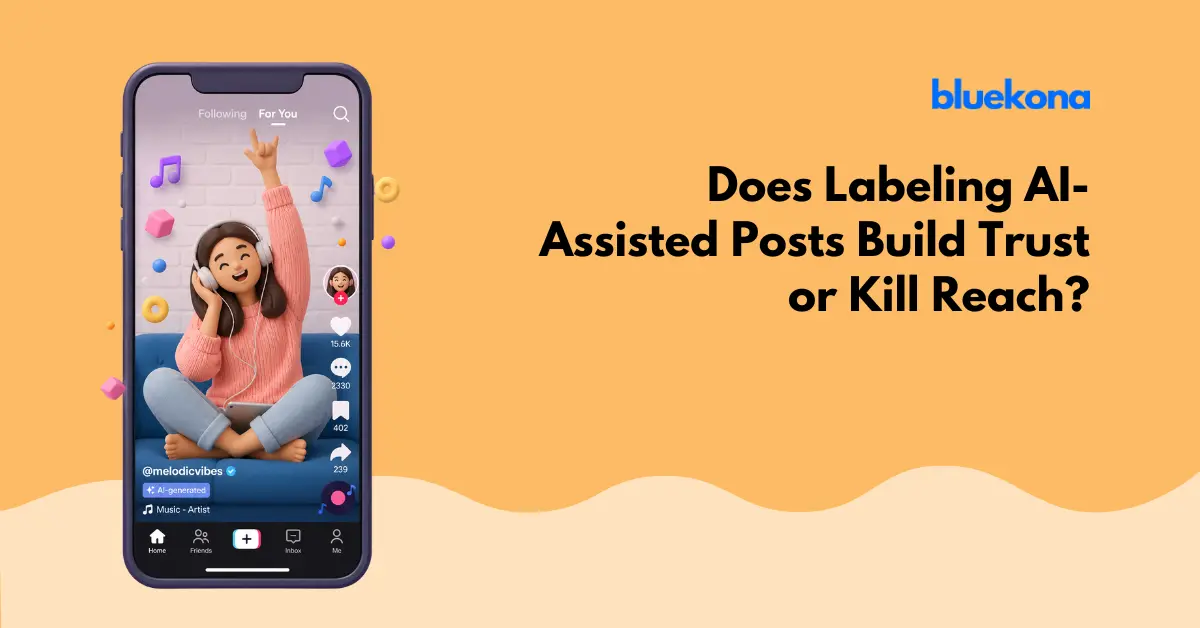
AI Content Disclosure, Does Labeling AI-Assisted Posts Build Trust or Kill Reach?
Somewhere in your feed right now sits a caption that reads a little too polished and a little too fast to have been typed by hand. You scroll past without deciding whether a human or a tool wrote it, mostly because you cannot tell, and the brand that posted it never said either way.
That uncertainty is the normal state of social media in 2026. AI tools have moved past the experimental phase inside marketing teams and into daily habit. 87% of marketers now use AI for social media, and 89.7% of social media professionals reach for an AI tool several times a week, according to Sociality.io’s 2026 AI in Social Media Marketing report. The tools are no longer a novelty. They are the default first draft.
What has not settled is what brands owe their audience once that draft goes live. Do you say a caption started as a prompt. Do you mention a product image was generated instead of shot. The platforms are now answering that question whether marketing teams like it or not, and the consumer data on what happens next is messier than most teams expect.
Why This Question Won’t Go Away in 2026
Every content calendar built this year runs into the same quiet decision point. A tool helped write this caption, clean up this photo, or generate this video clip. Saying so used to feel optional, almost like admitting you used a spellchecker. It no longer works that way.
Platforms have started making the choice for brands, and audiences have opinions that do not sit still long enough to build a simple rule around. A founder posting three times a week does not have the bandwidth to run a research study before every post. What they need is a clear read on what the data actually says, and a workable policy they can apply without overthinking each caption. That is what the rest of this piece is built to give you.
The tension worth naming early is this. Consumers say, loudly and consistently, that they want transparency. Then, in the same surveys and in controlled studies, they respond to visible AI labels by trusting the content less and engaging with it less. Holding both of those facts at once is uncomfortable, but it is also the actual situation SMB marketers are operating inside right now.

People say they want the truth about your content, then they get grumpy the second they actually see it. Welcome to marketing in 2026.
What the Platforms Now Require
Brands debating whether disclosure is worth the trust hit are increasingly finding the decision made for them. Each major platform has landed on a different enforcement model, and the differences matter for how much control a small team actually has.
TikTok’s Automated Detection
TikTok now requires visible labels on AI-generated visuals and audio that depict realistic people or scenes. The platform reads C2PA Content Credentials to catch synthetic media automatically, even when a creator skips the disclosure step entirely. After three unlabeled AI videos, TikTok cuts account reach by roughly 60% for 30 days and pauses Creator Fund earnings during that window.
Meta’s In-Post Tag
Meta unified its AI content rules across Instagram and Facebook in February 2026. Disclosure now has to appear as a tag above the post itself, separate from the caption, similar in placement to a paid partnership label. Burying an AI disclosure in the ninth line of a caption no longer satisfies the requirement.
YouTube’s Manual Flagging
YouTube still relies on creators to flag AI-generated content themselves, with penalties building for repeated failure to disclose. It is the least automated of the three systems, which puts more responsibility, and more room for judgment calls, on the creator.
| Platform | Disclosure method | Detection | Penalty for skipping it |
|---|---|---|---|
| TikTok | Visible label on synthetic visuals or audio | Automated | Reach cut ~60% for 30 days after 3 violations |
| Meta | In-post tag above the content | Manual | Content restrictions, tag added if missed |
| YouTube | Creator-flagged disclosure | Manual | Escalating penalties for repeat non-disclosure |
The Trust Data Is a Contradiction
What Consumers Say They Want
Ask people directly and the answer is close to unanimous. 91% of consumers expect brands to disclose when AI played a role in their marketing, according to Fractl’s 2026 AI Search Consumer Trust Study. Yet only 20% of organizations always disclose, and 33% never do. That gap between what audiences expect and what brands actually deliver is the real starting point for any disclosure policy.
What Happens When They See the Label
Here is where it gets uncomfortable. The same Fractl research found that only 7% of consumers say visible AI-generated content makes them trust a brand more, while 31% say it makes them trust the brand less. Wanting transparency in principle and rewarding it in practice turn out to be two different behaviors.
The Real Question Isn’t Whether to Disclose
Platforms have already removed “quietly hide it” as a viable long-term option. The actual decision left for SMBs is what to disclose, how specifically, and how that disclosure is worded, since those choices are what separate a trust-building label from a trust-damaging one.
TikTok reading your content’s digital fingerprints means hiding AI use isn’t a strategy anymore. It’s just a risk you’re choosing to take.

Why Labels Sometimes Kill Reach (and Sometimes Don’t)
Recent academic work on AI content labeling adds useful nuance to the blunt trust numbers above. Studies published through 2026 found that labeling content as AI-generated or AI-assisted reduced both emotional and behavioral engagement compared to unlabeled human-created content, especially for posts built around an emotional hook. Once someone knows a post came from a tool, they respond to it differently, often less warmly.
But at least one study found a more encouraging pattern sitting underneath that headline result. Disclosure had a positive moderating effect on the relationship between content inauthenticity and engagement, meaning that when the underlying creative was strong, labeling it as AI-assisted protected engagement rather than tanking it. The label itself is not automatically the problem. A weak, obviously synthetic post that also gets labeled tends to underperform twice over. A strong, well-made post that gets labeled tends to hold up.
This is the piece most SMBs miss when they read a scary headline about AI labels killing reach. The label is not erasing good content. It is removing the cover that let mediocre content coast on ambiguity. If you have been relying on your audience not noticing the difference, that grace period is closing. If you are using AI tools well, inside a real content lifecycle rather than as a shortcut around effort, disclosure is far less risky than it looks on paper.
The Gen Z Problem
The demographic split in this data deserves its own section because it changes the calculus depending on who your audience actually is. Half of Gen Z say they have unfollowed, muted, or blocked an account because they believed its content was AI-generated. That is not a mild preference. That is an active rejection behavior, and it is concentrated in exactly the age group most SMBs are trying hardest to reach on Instagram, TikTok, and Threads.
Older audiences, by contrast, tend to respond more to whether the content is useful and well made than to whether a tool touched it along the way. A brand serving a 45-plus audience on Facebook is working with a very different risk profile than a brand chasing 19-year-olds on TikTok. Your disclosure policy should account for that split rather than applying one blanket rule across every platform you post on.
A Disclosure Framework for SMBs (What to Label, What Not To)
The distinction that actually matters is not “did AI touch this content” in some abstract sense. Nearly every post touches AI somewhere now, whether that is a grammar check, a scheduling tool, or a caption idea. The distinction that matters is between AI-assisted work, where a human wrote the real substance and used a tool to speed up production, and AI-generated work, where the tool produced the core content itself, especially realistic images, video, or audio of people.
Using AI to brainstorm caption ideas you then rewrote yourself. Using AI to resize or color-correct a photo you actually shot. Using AI for grammar and spell checking.
A fully AI-generated image or video, especially one depicting a realistic person. AI-written copy that ran with no meaningful human edit. A synthetic voiceover standing in for a real person.
That split lines up with what most consumers actually seem to object to. The trust data is not punishing brands for using a grammar checker. It is punishing brands for letting a fully synthetic image or video pass as authentic without saying so. Framing your policy around this distinction, rather than trying to disclose every single tool touchpoint, keeps you honest without turning every caption into a legal disclaimer.
How to Disclose Without Undercutting Your Own Content
Wording matters more than most brands assume. A flat, generic label like “AI-generated content” reads as a compliance stamp and does little to build trust on its own. A specific, human sentence does more work. Something like “we used AI to help draft this caption, then edited it ourselves” tells your audience exactly what happened and signals that a person was still involved and cared about the result.
Be specific about what the tool did.
“AI-assisted” tells your audience nothing on its own. “AI helped generate the visuals, our team wrote the copy” tells them everything they need.
Put the disclosure where the platform expects it.
Follow Meta’s in-post tag placement or TikTok’s on-screen label rather than burying a mention deep in the caption, since audiences and moderation systems both read prominent placement as more honest.
Pair disclosure with your strongest creative, not your weakest.
Since the research shows labels protect engagement when the underlying content is strong, do not save disclosure practice for your lowest-effort posts.
Test the wording itself.
Treat disclosure language like any other content variable. Run one version against another the same way you would test a hook, following the same one-variable-at-a-time approach covered in our piece on organic content experiments without a budget.

Disclosure isn’t a confession booth. It’s a chance to remind people a real person is still steering the ship, and that’s worth saying out loud.
Turning Transparency Into a Trust Advantage
Most of the brands your audience follows are still treating disclosure as a liability to minimize rather than a habit to build. That gap is an opening. A brand that discloses clearly, pairs that disclosure with genuinely strong creative, and keeps a real human voice active in the process is doing something the majority of accounts in any given feed are still avoiding.
This only works as a long-term habit if you are also watching how your audience actually responds, not just guessing. That is where a real human brand approach and consistent auditing work together. You cannot fix a disclosure policy you are not measuring, and most small teams have no clean way to see whether a labeled post is landing differently than an unlabeled one across YouTube, Instagram, Facebook, and Threads at once.
Brands that treat AI as one tool inside a broader strategy, rather than the whole strategy, tend to scale with AI without losing the trust that got them followers in the first place. Disclosure is not the enemy of growth. Sloppy, unexamined use of AI is. Get the distinction right, and transparency becomes one more reason your audience sticks around instead of one more reason they scroll past.