
The Complete Social Media Guide for Dentists That Actually Brings Patients
A few years ago, posting a before and after photo or a “we now offer implants” update was enough to get some attention. People were browsing. They would scroll past your clinic page, see your name, and maybe remember it when they needed a dentist.
That is not how it works anymore.
Today, patients treat Instagram, TikTok, and YouTube the same way they used to treat Google. They type in questions. They search for answers. They watch videos to understand what a procedure looks like before they even think about booking. By the time someone actually calls your clinic, they have already watched three videos about root canals, read comments from other patients, and decided whether they trust you.
And here is the part that changes everything: most of that decision happens before they ever visit your website.
So if your social media is full of service lists and promotional posts, you are showing up too late. Patients have already moved on to the clinic that answered their actual question.
The shift in one line: Patients used to find you and then decide. Now they decide, and then find you.
Stop Posting Like a Clinic. Start Talking Like a Human
Here is a simple test. Read these two versions of the same idea out loud and notice how they feel.
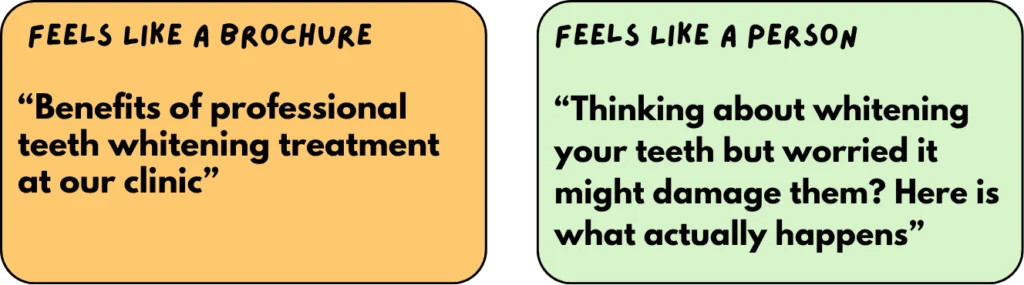
The first version sounds like something you would read on a waiting room pamphlet. The second one sounds like a friend who happens to be a dentist. And that is exactly the difference.
People do not think in keywords. They think in feelings and questions. “Will this hurt?” “Is my gum bleeding because something is wrong?” “Can I wait another month or do I need to go now?” When your content mirrors those thoughts, people stop scrolling. They feel like you are speaking directly to them.
Conversational content also builds trust much faster than clinical language. When you sound approachable, patients feel like they already know you before they walk through your door. That makes the call to book an appointment feel much less scary.
You do not need to dumb down your expertise. You just need to say it in a way that feels like a real conversation, not a textbook.
The Question-Led Content Strategy That Actually Works
The highest-performing dental content on social media right now is not about showcasing services. It is about answering questions patients are already asking.
Think about it this way. If someone is lying in bed at 11pm with tooth pain and they open TikTok, what are they searching for? Not “dental clinic near me.” They are searching “why does my tooth hurt more at night” or “tooth pain that comes and goes.” The clinic that has a video answering that exact question is the one they remember in the morning when they pick up the phone.
The three questions that drive most dental content searches: “Why does this happen?” and “Is this normal?” and “What should I do right now?”
Here are examples of what this looks like in real posts:
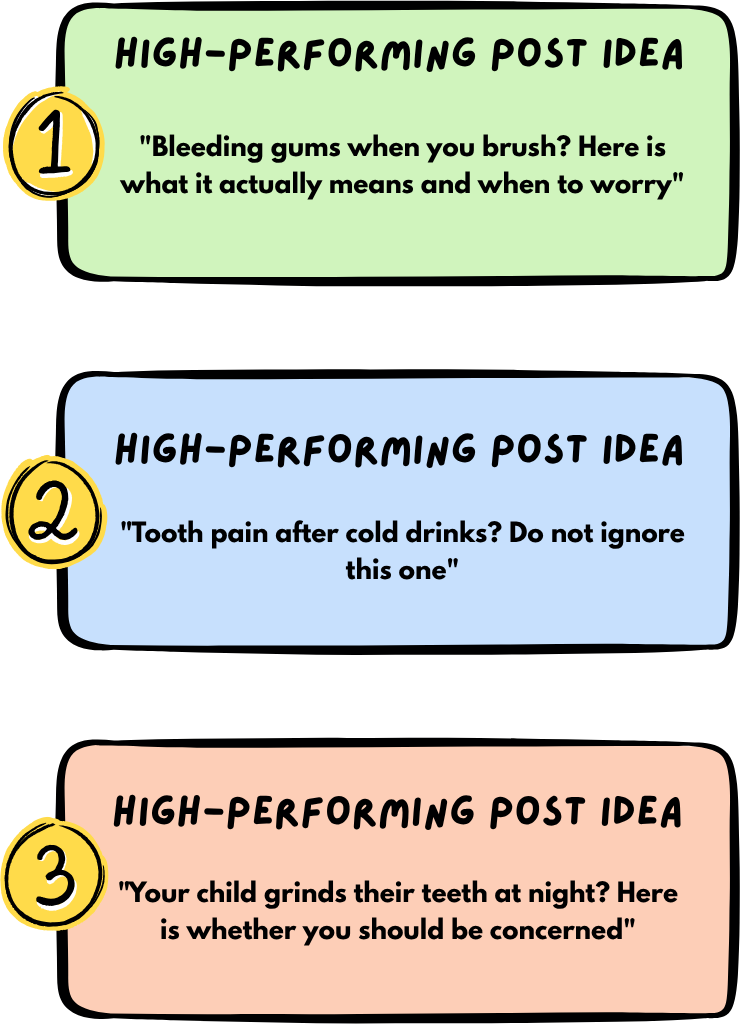
Notice how every single one of those sounds like something a patient would actually say out loud. That alignment is not a coincidence. It is strategy. And it works both because it matches how social algorithms decide what to show people, and because it matches what patients are genuinely searching for.
One Post Should Deliver One Answer
This is the mistake nearly every dental clinic makes. They try to pack too much into a single post. A caption about implants that also mentions whitening, with a call to book, and a mention of their location, and a hashtag about their team culture.
Patients do not read any of it.
When a post tries to say too many things at once, the brain does not know what to hold onto. So it holds onto nothing. The patient scrolls past. You get a quick tap on the heart at best, but no real engagement, no saves, no return.
The rule is simple. One post. One question. One answer. That is it.
When you stick to one idea, something interesting happens. People save your post. They screenshot it to share with their partner. They come back to it. That behavior tells the algorithm your content is worth showing to more people. And more importantly, it tells real patients that you actually know what you are talking about.
Focused posts also stay in memory much longer. If you teach someone one clear thing about why their gum swells after eating, they will think of your name the next time their gum swells. That is how patients find their way back to you.
A Simple Structure That Keeps Patients Reading
You do not need to be a writer to create content that works. You just need a structure that guides the reader through. Here is the one that works best for dental content:
The 4-Part Dental Post Framework
Hook Start with the exact feeling or situation your patient is already in. “Tooth pain that gets worse at night?”
Problem Name what is actually happening and why. Keep it simple. No jargon.
Answer Give them the real answer. Do not tease it. Do not hide it behind “book now.” Just answer the question.
Next step Let them know what to watch for or when it makes sense to come in. Keep it soft and helpful, not pushy.
This structure works because it is skimmable. A patient can read the hook and the answer in under ten seconds. If it resonates, they read the rest. You earn their attention in layers rather than demanding it all at once.
Clarity always wins over cleverness in healthcare content. When someone is worried about a symptom, they do not want wordplay. They want to understand what is happening to them. Be the voice that makes them feel like they finally get it.
Zero-Click Content Is No Longer Optional for Dentists
There was a time when “read more on our blog” was a reasonable thing to say at the end of a post. That time has passed.
Patients today do not want to leave the app they are already on. They do not want to click a link, wait for a website to load, and then hunt through a long article. They want the answer right there, right now, in the post itself.
Zero-click content means exactly that. The full answer lives inside the post. No link needed. No blog visit required.
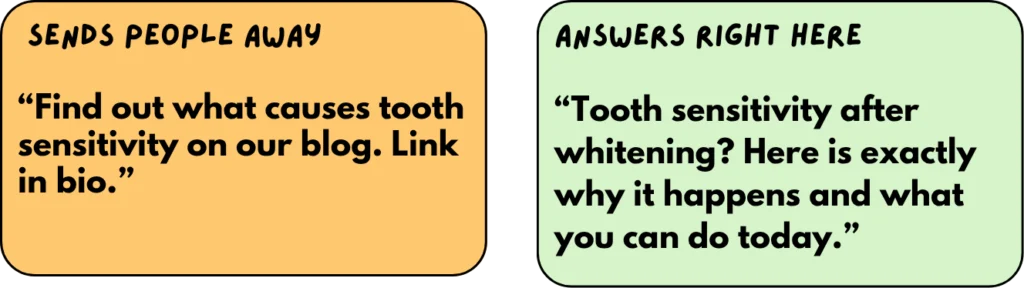
The second version does not need a click. The patient gets what they came for and walks away feeling like your clinic is genuinely helpful. That feeling is worth more than a website visit.
Zero-click content also does something important for dental marketing specifically. It reduces the anxiety patients feel before booking. When someone already understands what a procedure involves, what the recovery looks like, and what questions to ask, they feel far less nervous about calling. You are not just building an audience. You are building readiness to book.
And when patients feel ready, they come to you first because you are already the dentist they trust.
Real-Life Scenario Content Drives More Patient Action Than Anything Else
The best-performing dental content always starts with a real moment. Not a fact. Not a statistic. A situation that feels familiar.
Think about the difference between these two openings:
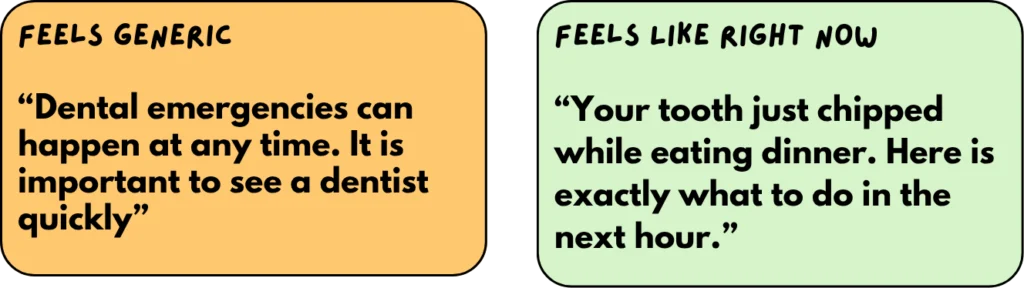
When someone is in that moment, they feel like you wrote the post just for them. That is not an accident. That is the entire point.
Scenario-based content works because it carries emotional weight. The person reading it is not just absorbing information. They are relating to it. They have been in that exact situation, or they know someone who has, or they are worried it might happen to them. That emotional connection is what drives them to save the post, share it, and remember your name.
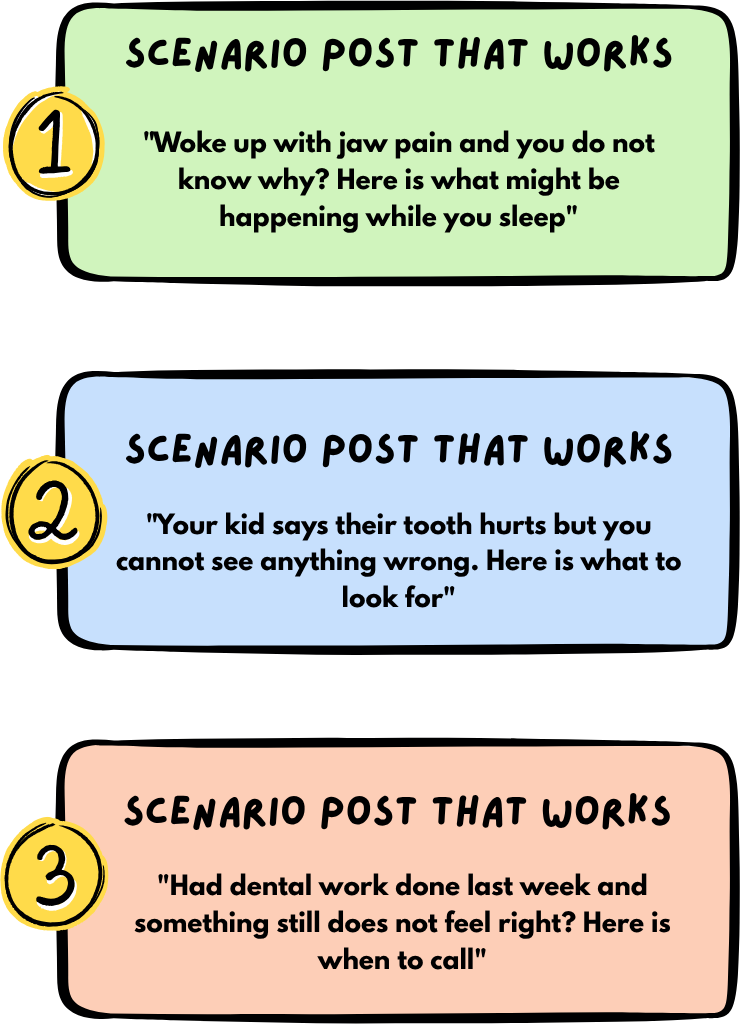
Notice how every one of these starts in a moment that a patient is actually living. Not a procedure. Not a service. A real, everyday situation where someone needs a clear and calm voice to guide them. Your clinic can be that voice.
The Business Reality: Where Most Dental Clinics Go Wrong
Everything we have talked about so far builds trust. And trust is the foundation of every appointment that gets booked. But here is where a lot of dental clinics hit a wall.
They start posting better content. The engagement goes up. They get more saves and comments. But months later, they still cannot tell you which posts actually led to new patient inquiries. They cannot tell you which topics drove someone to send a DM asking about pricing. They cannot tell you whether the video content or the carousel posts are doing more work for them.
So what happens? They guess. They post whatever feels right that week. They copy what a competitor did. They try a trend that has nothing to do with their patients. And slowly the strategy that was working starts to drift because there is no data anchoring it.
- No way to connect content to actual patient inquiries
- No clarity on which topics are building real trust
- No way to tell if video is outperforming carousels for their specific audience
- Posting randomly instead of intentionally
- Optimizing for likes instead of patient intent
The result is a clinic that is working hard on social media without knowing if any of it is working. That is an exhausting place to be. And it is completely avoidable.
Where Bluekona Comes In
Dentists do not need to post more. They need to know which posts are actually doing something. That is the gap Bluekona fills.
Bluekona looks at the signals your content is already sending and turns them into something you can act on. Not just likes and reach, but real indicators of patient interest. Which posts led to a profile visit? Which topics drove someone to send a message? Which format made people stop scrolling long enough to actually read what you wrote?
- Find What Converts: Identify which patient questions your content answers that actually lead to inquiries, not just views.
- Track Real Intent: See which posts drive profile visits, DMs, and link clicks, so you know what is moving people to act.
- Compare Formats: Understand whether video, carousels, or text posts work better for your specific audience on each platform.
- Spot Patterns: Detect what topics consistently build trust versus what gets a quick scroll-past and nothing more.
Most analytics tools tell you what happened. Bluekona helps you understand why it happened and what to do next. For a dental clinic, that difference is enormous. Because the goal is never more followers. The goal is more patients who already trust you before they walk in the door.
“It is not about posting more dental content. It is about knowing what makes patients choose you.”
The One Rule Every Dentist Should Follow Before Posting
Everything in this guide comes down to one question. Before you write a caption, record a video, or design a post, ask yourself:
“Would a patient actually say this out loud?”
If the answer is no, rewrite it until the answer is yes.
Patients do not walk into a clinic saying “I am interested in comprehensive restorative dentistry.” They walk in saying “my tooth has been hurting for two weeks and I am finally scared enough to come in.” They text their friends “my gums bleed every single time I brush, is that normal?” They ask their partner “do you think I actually need a root canal or are they just saying that?”
Your content should sound like the answer to those real conversations. When it does, something shifts. Patients feel like you already understand them. They feel less anxious about coming in. They feel like they have already had a conversation with you, even though you have never met.
That is the advantage that no ad budget can buy. You earn it through content that respects how patients actually think and what they actually need to hear.
The clinics winning on social media right now are not the ones with the biggest teams or the fanciest equipment photos. They are the ones who figured out that showing up as a helpful, honest, knowledgeable human is worth more than any promotional post they could ever write.
Start there. Keep that question close. And use what you learn from your content to keep getting better at it.