
What Is a Social Media SWOT Analysis and How to Do It Step-by-Step
Social media moves fast — one week your content is blowing up, the next your engagement tanks and you’re not sure why. You’re posting consistently, testing formats, and watching competitors, but are you actually learning from your data?
That’s where a social media SWOT analysis comes in.
It’s more than a marketing acronym — it’s a framework for clarity. A structured way to evaluate your Strengths, Weaknesses, Opportunities, and Threats across platforms so you can see what’s working, what’s broken, and what’s next.
In short: creativity grabs attention, but clarity drives growth.
And thanks to AI tools like bluekona, you can automate the entire process — pulling performance data from every platform, visualizing insights instantly, and turning them into strategy without ever touching a spreadsheet.
In this guide, we’ll break down what a social media SWOT analysis is, why it matters, and how to run one step-by-step so your next post isn’t just another guess — it’s a calculated move.
Step-by-Step: How to Conduct a Social Media SWOT Analysis
Running a social media SWOT analysis doesn’t need to be complicated or time-consuming. Here’s a straightforward, data-driven approach you can follow — with or without AI tools.
Step 1: Define Your Goals
Before diving into data, decide what success looks like for you.
Are you optimizing for engagement, lead generation, brand awareness, or community growth?
Your goals determine which metrics actually matter — and they’ll shape every decision that follows.
💡 Tip: Be specific. “Increase engagement” isn’t a goal — “Raise Instagram engagement rate by 20% in Q4” is.
Step 2: Gather Your Analytics
Collect data from every active platform — Facebook, Instagram, YouTube, LinkedIn, TikTok, or X (formerly Twitter). Focus on both content performance and audience behavior.
Track metrics such as:
- Engagement rate (likes, comments, shares, saves)
- Reach and impressions
- Click-through rate (CTR)
- Follower growth
- ROI from paid and organic content
- Audience demographics and sentiment
This is where things usually get messy — multiple dashboards, CSVs, and manual sorting.
bluekona shortcut: Instead of juggling data from five different platforms, bluekona pulls it all together automatically and generates actionable insights — no spreadsheets required.
Step 3: Identify Your SWOT
Now organize your findings into the four SWOT categories.
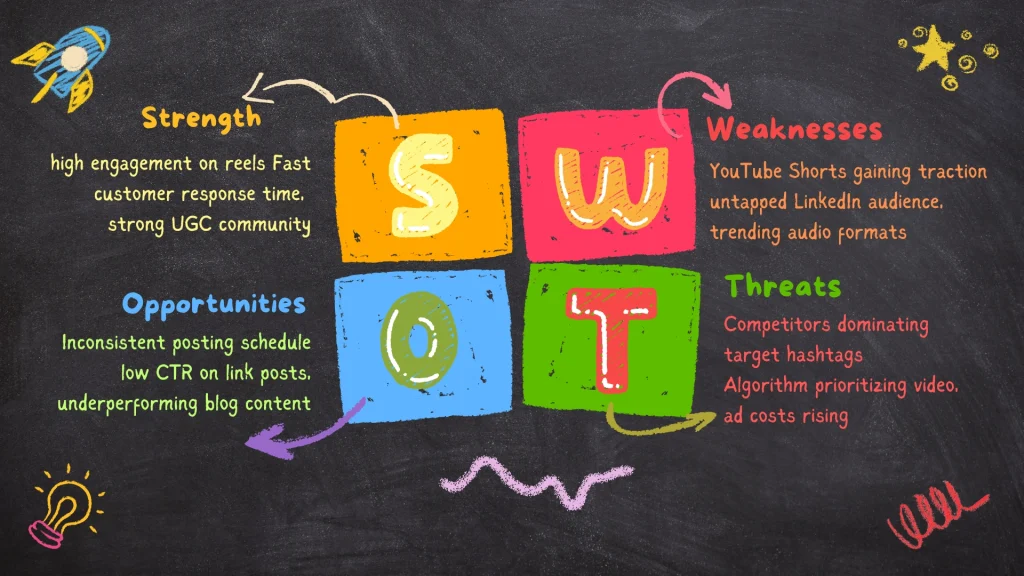
Be brutally honest here — real growth happens when you confront weaknesses and threats head-on.
Step 4: Benchmark Against Competitors
Your SWOT doesn’t exist in a vacuum.
Compare your performance to others in your niche. Look at:
- Engagement and posting frequency
- Content formats and creative quality
- Hashtag and keyword strategies
- Audience sentiment and share of voice
This step shows you not just how you’re performing — but where you’re winning or falling behind.
Tip: Run a competitor audit alongside your SWOT to see where you outperform and where you’re losing ground
Step 5: Turn Insights Into Strategy
A SWOT analysis means nothing if it just sits in a deck. Turn your insights into 3–5 focused actions.
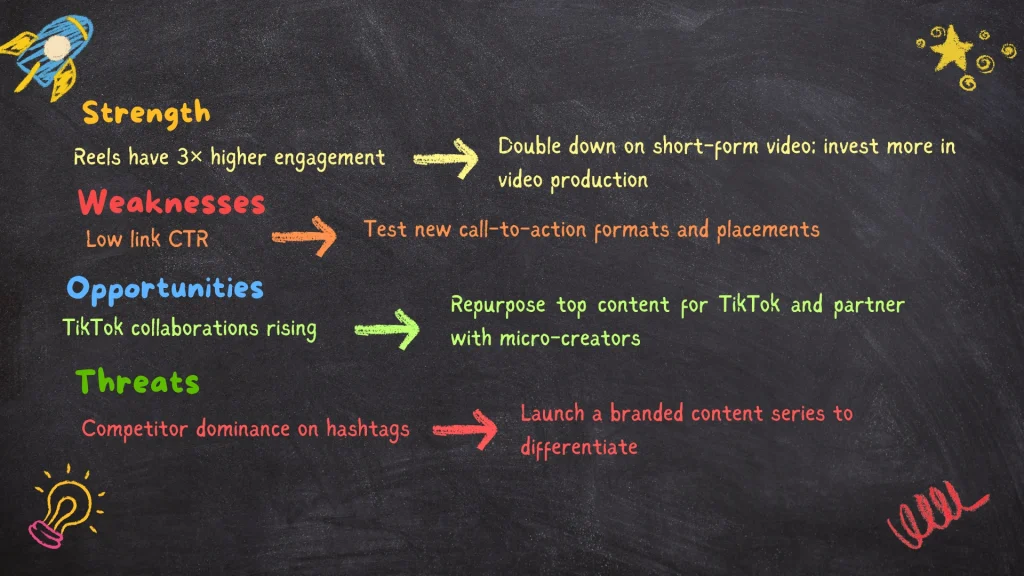
Track progress monthly and refresh your SWOT quarterly. Social media shifts fast — your strategy should evolve just as quickly.
Don’t Fall Into the Template Trap
You’ve probably seen those “free SWOT templates” floating around online — neat little grids promising clarity in four boxes.
But the problem is by the time you manually pull data from six platforms, fill it all in, and double-check performance trends… the algorithm has already changed.
Traditional templates are static snapshots in a real-time environment. They look organized, but they quickly become outdated — and worse, they hide insights that could actually move the needle.
If you’re serious about staying competitive, you need a system that updates with your data — not one you have to babysit.
The smarter approach: Skip the spreadsheets. With bluekona, your SWOT analysis updates automatically using live social data — giving you fresh insights as your audience and platforms evolve.
No more manual grids. No more lagging insights. Just actionable clarity, powered by real-time performance.
From SWOT to Strategy: Turning Insight into Action
A SWOT analysis isn’t the finish line — it’s the launchpad.
The real value comes when you turn insight into momentum and decisions that actually move the numbers.
1. Focus Where You Win
If your strengths lie in short-form video or community engagement, lean in hard. Reallocate time, budget, or creative energy toward the formats and platforms delivering the highest ROI.
Then test variations to keep what’s working… working even better.
2. Fix the Weak Spots
Every weak link costs you growth. If your posting is inconsistent, build a content calendar or automate scheduling. Low engagement? Audit your CTAs, captions, and creative. Slow response times? Set up auto-replies or dedicate daily engagement blocks.
Small fixes compound into major performance gains.
3. Double Down on High-ROI Platforms
Not every platform deserves equal attention.
Use your SWOT data to identify where your audience converts best — and concentrate resources there. It’s better to dominate two channels than to be mediocre on five.
4. Turn Opportunities Into Experiments
Spotted a rising trend or new feature?
Treat it as a low-risk test, not a full-scale pivot. Repurpose top-performing content into new formats like YouTube Shorts or TikTok collabs and measure early results before scaling.
5. Mitigate Threats Before They Escalate
Competitors, algorithms, and ad costs will always shift. Use your SWOT to anticipate — not react.
Have contingency plans ready: diversify content formats, grow owned channels, and maintain creative agility.
6. Track, Measure, Evolve
Set benchmarks, monitor progress monthly, and revisit your SWOT quarterly.
Social media moves fast — your strategy should evolve just as quickly.
bluekona connects your SWOT findings to your full content workflow — helping you plan, post, and pivot with precision. Real-time data, continuous insight, zero guesswork.
FAQ
What is a social media SWOT analysis?
It’s a structured method for identifying the strengths, weaknesses, opportunities, and threats in your social media marketing strategy.
Why should marketers perform it regularly?
Because algorithms, audience behavior, and competitor activity change constantly. Regular SWOTs keep your approach sharp and relevant.
How often should I conduct one?
At least quarterly — or monthly if you manage multiple accounts or run ongoing paid campaigns.
How can AI make the SWOT analysis of my social media accounts easier?
AI tools like bluekona automate the data collection, analysis, and visualization steps, freeing you to focus on strategy and content creation.
Ready to Run Your Social Media SWOT Analysis?
You don’t need to be a data analyst to understand your strengths and weaknesses. You just need the right tools to surface the insights that matter.