
How Different Generations Use Social Media and How Brands Should Actually Build for Them
Most brands treat social media like one big room with one big audience. It is not. It is three completely different worlds running at the same time, and what works in one world will fall flat in the other two.

Social media started as a place to post updates and stay in touch with people. That version of social media does not really exist anymore. Today, people use social media to search for things, study a product before they buy it, and decide who they trust.
Think about how people in your life actually use these platforms. A 21-year-old opens TikTok to search for coffee shops near them. A 34-year-old checks Instagram to see if other parents are buying a specific baby monitor. A 47-year-old goes on Facebook to read real reviews before signing up for a service. Three people. Three completely different journeys. Same general idea of “being on social media.”
The brands that are winning right now understand this. They are not posting one piece of content and hoping it lands with everyone. They are building with a specific person in mind each time. And the brands that are struggling? They are still thinking of their audience as one group.
You do not need more content. You need the right content for the right person at the right moment.
How Gen Z Actually Uses Social Media
Gen Z does not just use social media. They live on it. For them, it is not a leisure activity they check once a day. It is the main way they find out about the world. This generation grew up with smartphones in their hands, and they have built habits that most older marketers still find hard to believe.
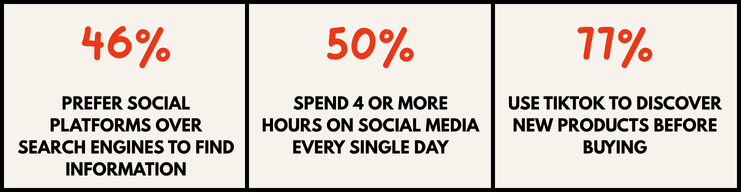
What this tells you is that for Gen Z, social media is basically Google, YouTube, and Amazon combined into one place. When they want to find something, they go to TikTok or Instagram. When they want to learn something, they look for a short video. When they are ready to buy something, they check what creators they follow are saying about it.
What Gen Z Expects From a Brand
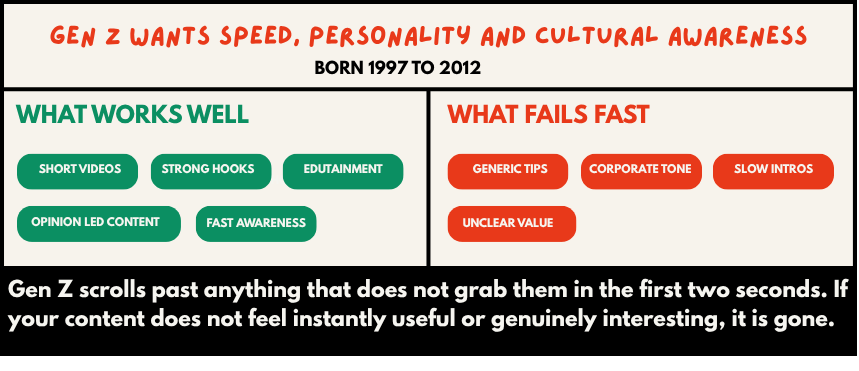
Gen Z is not looking for products. They are looking for experiences and identity. They want to follow brands that feel like they get the culture, that speak without corporate polish, and that have a genuine point of view. They respond to creators and voices that feel real. The moment something feels like an ad trying too hard to be cool, they are out.
This does not mean you have to chase every trend. It means your content needs to have a clear personality and deliver something fast. A useful tip, a funny take, an honest opinion, a quick answer to a question they already had. That is the currency on this side of social media.
How Millennials Use Social Media to Make Real Decisions
Millennials are the most active generation on social media by volume. They manage more accounts than any other group, and they use social media with a mix of intention and habit. They are on Instagram, Facebook, LinkedIn, Pinterest and sometimes TikTok too. But the way they use these platforms is very different from Gen Z.
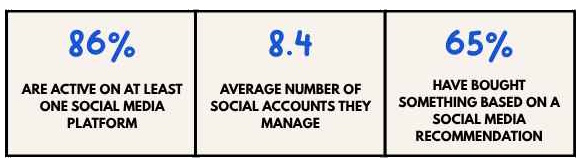
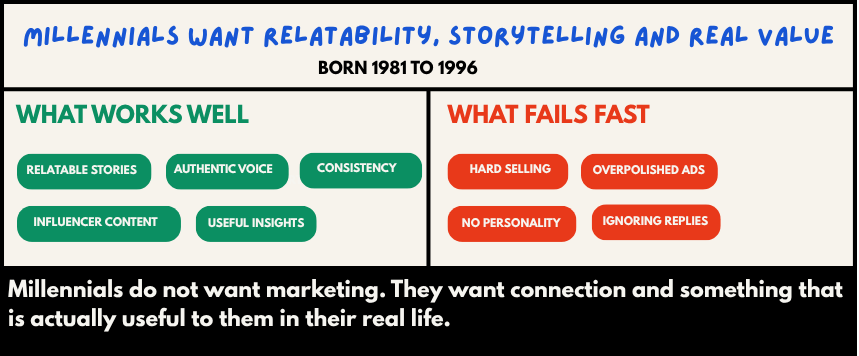
For Millennials, social media is where they stay connected with people and validate the decisions they are already considering. They are not just scrolling for fun. They are checking if a product is worth it, seeing what people like them are using, and looking for brands that feel human and honest.
The Millennial Purchase Path on Social Media
A Millennial who is thinking about buying something will often follow a brand for a while before they decide. They watch how the brand talks to people, whether they respond to comments, whether their content feels honest or scripted. They are also heavily influenced by people they already trust, which is why influencer marketing hits so well with this group. Not celebrity influencers necessarily, but people who feel like a real version of themselves.
If your brand shows up consistently, engages genuinely and delivers content that helps them make better decisions, Millennials will trust you. That trust turns into purchases and into loyalty.
How Gen X Uses Social Media and Why They Are Worth Your Attention
Gen X is the quiet one in the room. They do not post as much, they do not go viral, and they do not spend hours scrolling through TikTok challenges. But do not make the mistake of overlooking them. They are intentional, they have purchasing power, and when they make a decision, they usually stick with it.
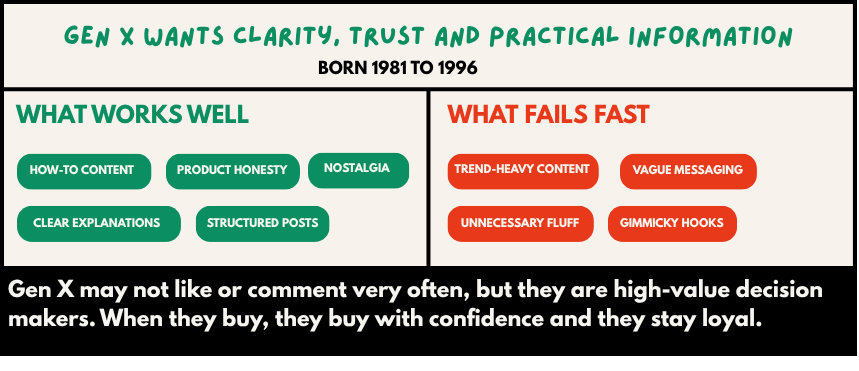
Gen X uses social media primarily on Facebook and YouTube. They use it to research before buying, to read reviews, to watch how-to content, and to stay in touch with people they actually know. They are not looking to be entertained. They are looking for answers.
Why Brands Should Not Ignore Gen X on Social Media
This generation has real spending power and they are tired of being ignored by brands that are too busy chasing younger audiences. Content that is clear, well-structured and genuinely useful goes a long way with them. They do not need to be impressed with trending audio or fast cuts. They need to feel like you respect their time and you are giving them something real.
The Real Problem Most Brands Are Running Into Right Now
One strategy does not fit three very different people
Most brands post the same piece of content across every platform for every audience. They copy trends without thinking about whether that trend makes sense for who they are talking to. They treat engagement as a single number instead of asking who is actually engaging and why.
The result is low engagement, weak conversions, and a brand that feels generic to everyone. You are spending time and money creating content that is not actually connecting with anyone in a meaningful way.
This is not a content problem. It is an audience understanding problem. And it is completely fixable once you start thinking about who you are actually talking to.
How to Build Content That Actually Works for Each Generation
Once you understand how each generation behaves on social media, building for them becomes a lot more straightforward. You do not need to create an entirely different brand voice for each group. You just need to meet each audience where they are.
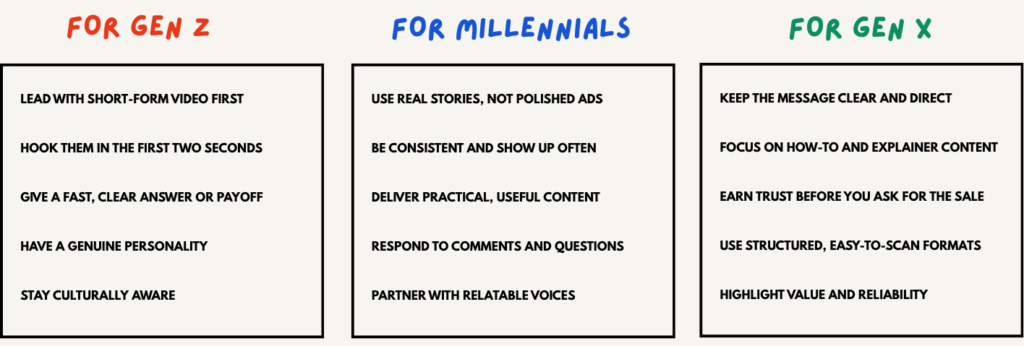
If Your Audience Spans Multiple Generations, Here Is What to Do
Most brands are not talking to just one generation. They have customers across the board, and that is where the real challenge lives. You cannot pick one format and call it a strategy. You need to think in layers.
The good news is that you do not need to triple your content output. You need to take one idea and execute it differently for each audience. Same message, different delivery.
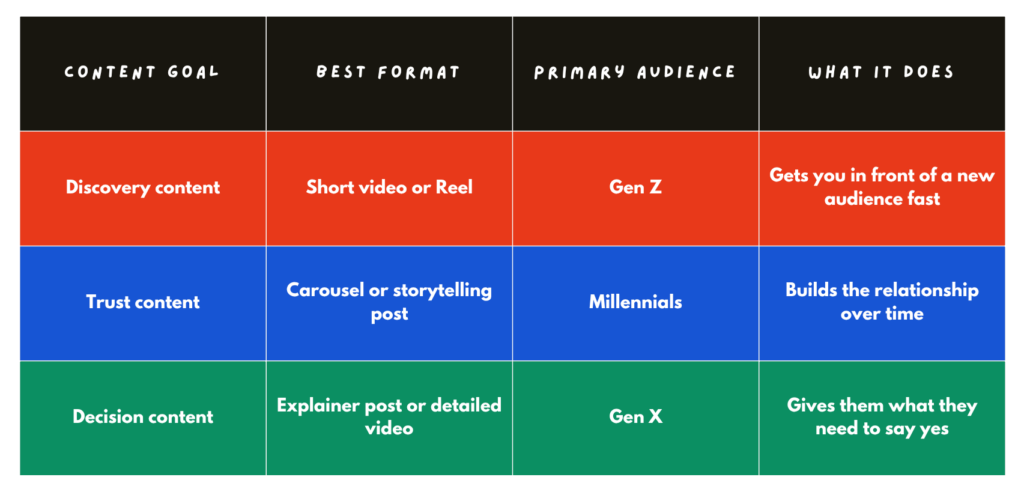
When you build in layers like this, you are not just posting more. You are scaling your relevance across multiple groups without confusing any of them. This is what it looks like to have an actual strategy instead of just a posting schedule.
How Kellogg’s Runs Three Separate Strategies at the Same Time
Kellogg’s is one of the clearest examples of a brand that understands generational behavior on social media. They do not run one campaign for everyone. They run three completely different approaches, built around how each generation actually uses social platforms.
The result is a brand that feels fresh to a 20-year-old on TikTok, relatable to a 35-year-old parent on Instagram, and reliable to a 50-year-old on Facebook. Same company, same products, three very different conversations.
Case Study: Kellogg’s Generational Playbook
Here is a look at how they approach each generation and what makes each approach work.
Gen Z
Kellogg’s shows up on TikTok, Roblox and Snapchat with bold, fast, experience-first content. They frame their products as snacks and lifestyle items, not boring breakfast cereal. Their messaging is direct, a little irreverent, and built around identity. Campaigns like gaming activations and hashtag challenges meet Gen Z where they already spend their time. They are not trying to convince Gen Z to buy cereal. They are trying to be part of the world Gen Z already lives in.
Millennials
On Instagram, Facebook and Pinterest, Kellogg’s talks to Millennials through health, convenience and family. They work with parenting influencers, share recipe content, and push positioning like “cereal for dinner” because it speaks to the real, messy, busy life that Millennials are actually living. It is not about features or nutrition facts. It is about fitting into a real person’s day without making things harder.
Gen X
For Gen X on Facebook and YouTube, Kellogg’s leans into nostalgia, familiar mascots and health messaging around things like heart health and digestion. They are not trying to be cool or trendy. They are trying to be trustworthy. They remind Gen X of a brand they have known their whole lives and give them practical reasons to keep buying it. Coupons, retail targeting and straightforward health claims do the heavy lifting here.
The Real Lesson From How Kellogg’s Operates
Most brands look at Kellogg’s and think the secret is budget. It is not. The secret is that they understand their audience well enough to build differently for each group. They do not guess. They look at who is engaging with what, which formats are driving results for which audience, and they adjust continuously.
That is the difference between posting and having a strategy. And it is the same difference that separates brands with growing social channels from brands that post consistently and wonder why nothing is moving.
Kellogg’s does not guess what works. They know who it works for. That is the whole game.
Where Most Teams Get Stuck and Why It Is Not Their Fault
Here is the hard reality. Most marketing teams know that their audience is not one homogeneous group. They can feel it when engagement is inconsistent and conversions do not match the effort they are putting in. But they keep posting the same way because they do not have a clear picture of what is actually working for whom.
They are running on assumptions, trends and gut feeling. They are not doing this because they are bad at their jobs. They are doing this because they do not have the data to make better decisions. They cannot see which generation is engaging with which content, which formats are driving the actions they actually care about, or what the intent is behind someone saving a post versus someone commenting on it.
Without that clarity, even a team full of talented people ends up creating content that tries to do everything and ends up doing nothing particularly well.
How Bluekona Helps You Stop Guessing and Start Knowing
This is exactly the gap that Bluekona is built to close. Instead of posting and hoping, Bluekona helps you understand what is actually happening inside your social content, who is engaging with it, and what is driving real outcomes.
With Bluekona, you can break down performance by format, by message type, and by platform. You can track the intent behind engagement, so a spike in saves on a how-to post tells you something very different from a spike in comments on a relatable story. And you can keep refining your strategy over time based on what the data is actually telling you, not what feels right in the moment.
The brands that win across generations are not the ones with the biggest budgets. They are the ones who understand their audiences well enough to build for them with intention. Bluekona gives you that understanding.
Ask These Three Questions Every Single Time You Make a Post
- Who is this piece of content actually for? Be specific. Name the generation, the situation they are in, the platform they are on.
- What problem does this solve for that person? Not for your brand, for them. What do they walk away with that they did not have before?
- Would this genuinely resonate with that person? Be honest. If you are not sure, that is a sign to rework it before you hit publish.
The Final Takeaway on Building a Social Media Strategy That Spans Generations
Social media is not one audience. It never was. But for a long time, brands could get away with treating it like one because the platforms themselves were simpler and the competition was lower. That time has passed.
Today, Gen Z is searching on TikTok. Millennials are building purchase decisions on Instagram. Gen X is doing their research on Facebook and YouTube. These are three completely different behaviors, three different expectations, and three different journeys to a purchase decision. If your content strategy does not account for that, you are leaving reach and revenue on the table every single day.
The brands that win on social media in the years ahead are going to be the ones who stop thinking about platforms and start thinking about people. They are going to build content with a specific person in mind, test what actually lands, study the data behind it, and keep improving.
You do not need to rebuild your entire strategy overnight. You just need to start asking better questions before you create. Who is this for? What do they need right now? Does this actually give it to them?
Start there. Then use the tools and data available to you to sharpen that instinct into something repeatable and scalable.