
Social Media Management vs Marketing: Why Most Brands Get It Wrong (And How to Fix It)
Most brands think that showing up on social media every day is enough. Post something in the morning, reply to a few comments, maybe throw in a reel, and call it a day.
But here is the thing. Posting consistently is not the same as growing consistently.
There is a big difference between managing your social media and actually marketing through it. Most brands either do not know the difference or treat them as the same thing. And that one mistake is quietly killing their growth.
Let us break it all down.
The Confusion That Is Costing You Growth
Here is what most brands believe: if we stay active on social media, the results will follow.
So they post every day. They stay consistent. They reply to comments. They keep the page looking alive.
But months go by and nothing much changes. No real bump in sales. No new customers coming in through social. Just a page that looks busy but is not really doing anything.
The problem is not effort. The problem is strategy disconnect.
Social media management and social media marketing are two very different things. They have different goals. They need different thinking. But most brands blur the line between them and end up doing neither well.
Once you understand how they are different and why they need to work together, everything starts to make more sense.
What Social Media Management Actually Is (And What It Is Really For)
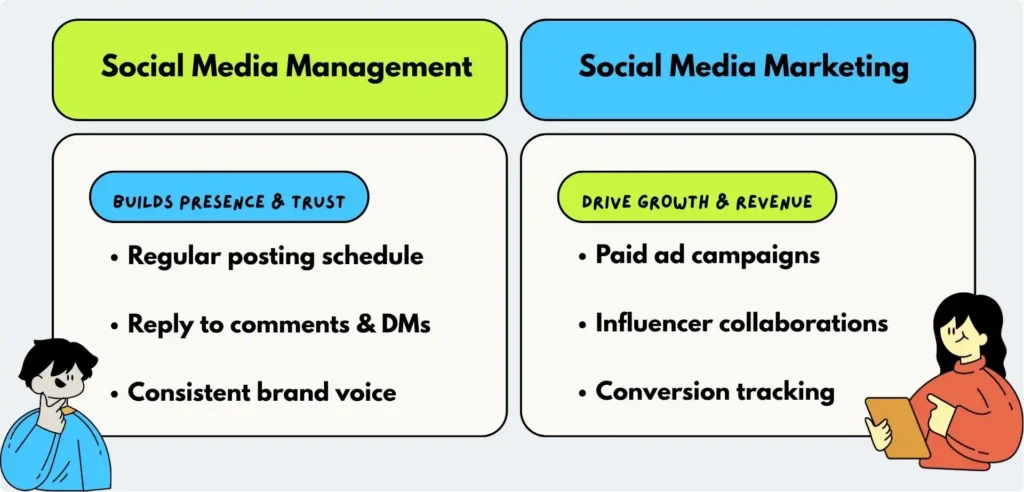
Social media management is about showing up. Every day, consistently, in a way that feels familiar to your audience.
It includes things like posting content on a regular schedule, replying to comments and messages, keeping your brand voice consistent across every post, and watching what people are saying about you online.
Now here is how most people think about management. They think it is just “the posting part.” Like a chore you tick off a list.
But that is the wrong way to look at it.
Management is actually building something invisible but very powerful. It is building familiarity. When someone sees your content three days in a row, then again next week, then the week after, something starts to happen in their brain. They start to recognise you. They start to trust you. They think, “these people are around. They seem real. I know them a little.”
That kind of trust does not happen from one viral post. It happens from showing up, over and over, in a way that feels human and consistent.
So management is not just posting. It is planting seeds of trust every single day.
What Social Media Marketing Actually Is (And Why It Feels Harder)
If management is about building trust, marketing is about turning that trust into action.
Social media marketing is the growth side of things. It includes running paid ads, partnering with influencers, building funnels that move people from seeing your content to actually buying something, and tracking what is working in terms of real numbers like clicks, conversions, and revenue.
Marketing feels harder because it is more direct. You are not just trying to stay visible. You are trying to get someone to do something. Click this. Buy this. Sign up for this. That requires more strategy, more testing, and more understanding of your audience.
But here is the reframe. Marketing is not just promotion. It is not just running ads and hoping people bite. Done right, it is turning attention into revenue in a way that is predictable and repeatable.
The key word there is attention. You need attention before marketing can work. And that is exactly what management builds.
The Real Problem: They Do Not Talk to Each Other
This is the part most brands miss entirely.
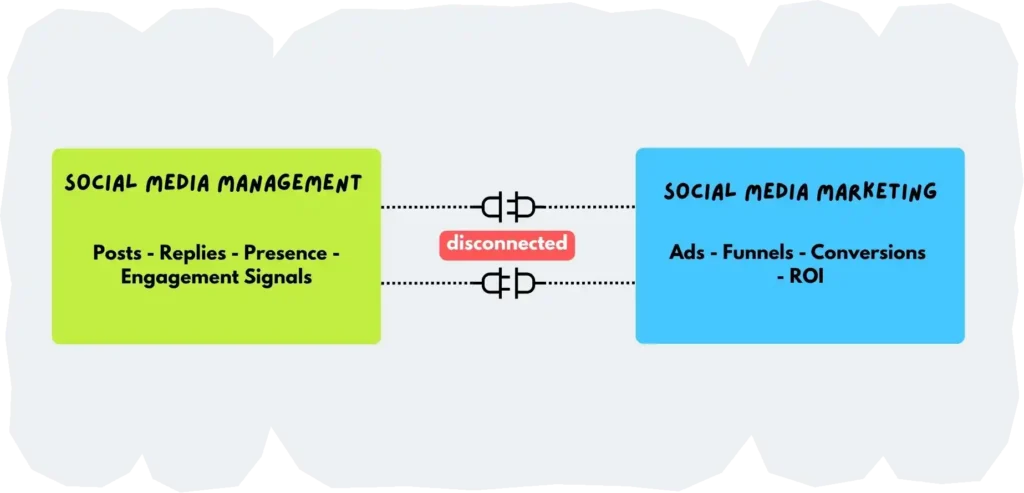
Management and marketing usually live in completely separate worlds inside a company. The person managing content is focused on posting schedules and engagement rates. The person running campaigns is focused on ad spend and conversions. They rarely sit in the same room and compare notes.
So what happens?
Your team keeps generating content. Some posts do really well. People love them. The comments are great. Lots of shares. But nobody takes that information and asks, “what made this work? Can we put money behind this and reach ten times more people?”
On the other side, the sales team runs campaigns. They pick creative based on what they think will work. But they are not looking at what has already proven itself in organic content. So they are guessing, spending money, and sometimes getting lucky.
There is no feedback loop. Content does not inform campaigns. Campaigns do not shape content.
The result is that effort keeps going up but impact stays the same. You are doing more and more but the needle is barely moving.
This is the real problem. Not a lack of content. Not a lack of budget. A lack of connection between the two.
Why Doing Only One of Them Will Always Fall Short
A lot of brands pick a lane. Either they go heavy on management or they go heavy on marketing. And both paths hit a wall eventually.
If you only focus on management, you feel busy and active. Your page looks great. Engagement is decent. But at the end of the month when someone asks what social media actually brought in for the business, the answer is not satisfying. You are visible but you are not growing.
If you only focus on marketing, you can get attention fast. Ads can put you in front of thousands of people overnight. But if those people land on your page and there is nothing there to trust, they leave. A thin content presence with no real history, no community, no voice makes even the best ad feel hollow. People do not buy from strangers, and a page with no soul feels like a stranger.
Here is the idea to hold onto.
Trust without reach does not scale.
Reach without trust does not convert.
You need both. And you need them working together, not running in parallel and never crossing paths.
How High Performing Brands Actually Win
The brands that are genuinely winning on social media are not posting the most. They are not spending the most on ads either.
What they are doing is learning the fastest.
They treat their organic content like a testing ground. Every post is an experiment. Which hook got people to stop scrolling? Which format got the most saves? Which topic made people tag their friends? They are watching all of this closely.
Then they take what works and they scale it. They put money behind the posts that already proved themselves. They build campaigns around the themes and messages that organic content showed actually resonate.
It is a simple loop but most brands are not running it.
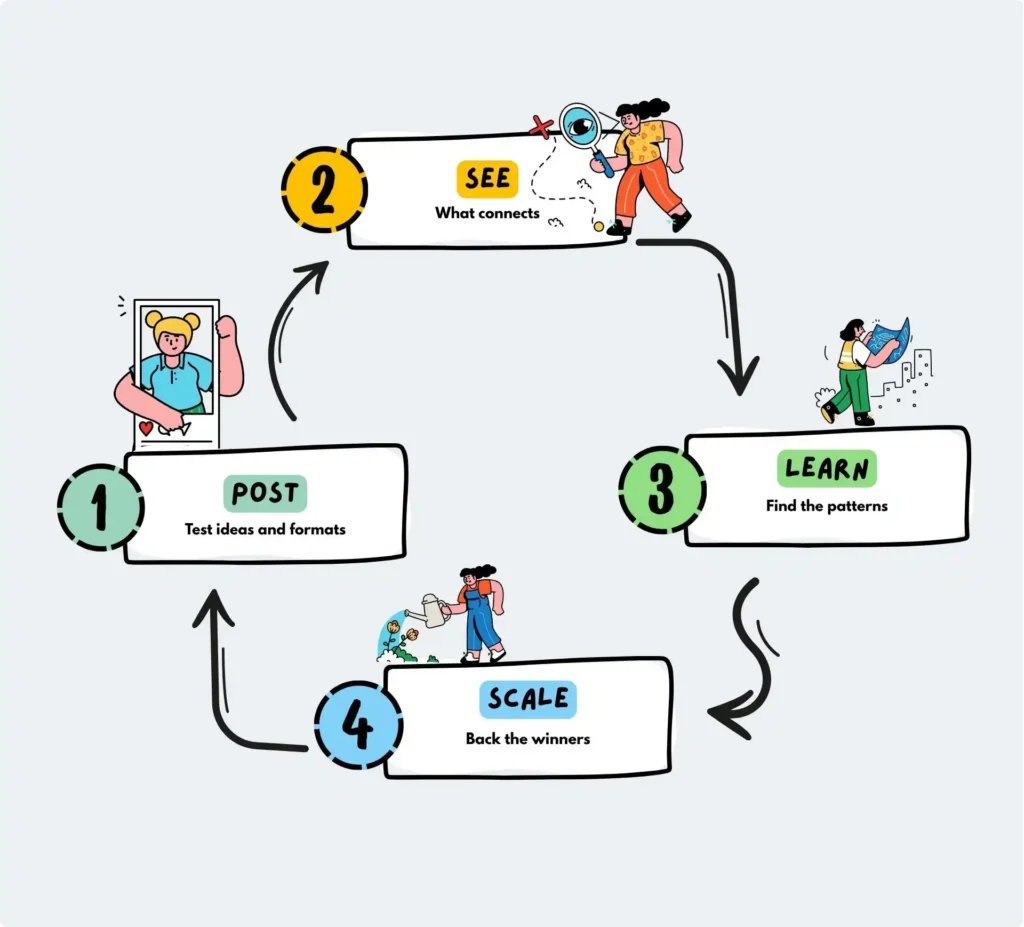
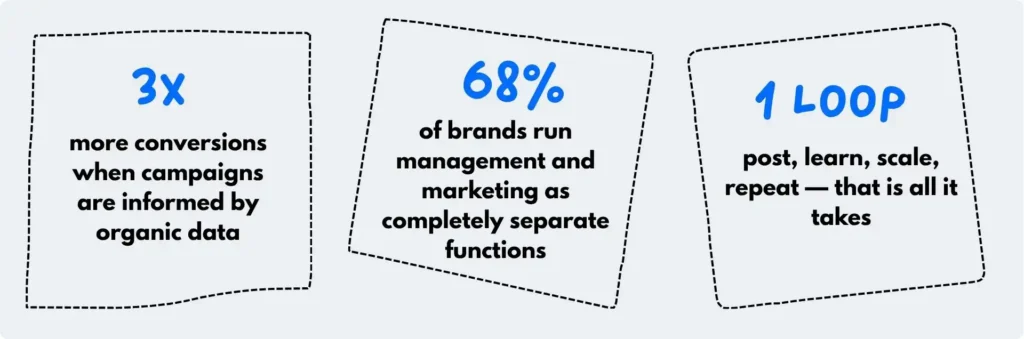
Post something. See what connects. Learn from it. Scale the winners.
Content leads to insight. Insight leads to campaigns. Campaigns lead to growth. And then that growth tells you what to do next.
The Missing Layer That Most Teams Overlook
Here is where things get interesting.
Most social media teams are tracking metrics. They know their reach numbers. They know how many likes a post got. They watch follower counts go up and down.
But there is a difference between tracking metrics and actually understanding what is happening.
Knowing that a post got a lot of likes is not the same as knowing why it got likes. And knowing why something worked is what lets you repeat it and scale it.
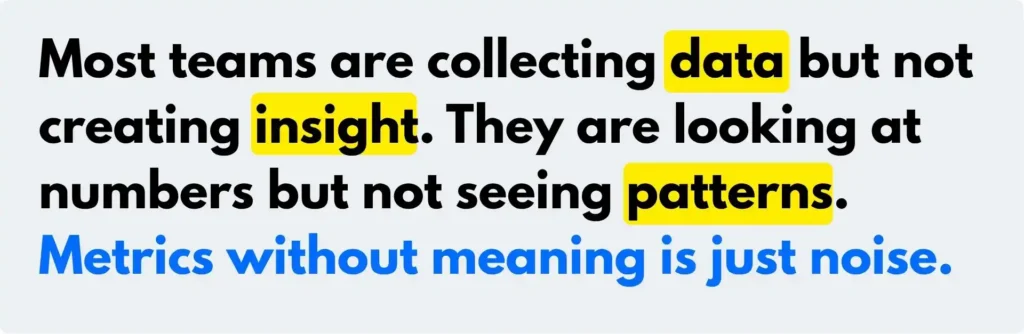
Most teams are collecting data but not creating insight. They are looking at numbers but not seeing patterns. They do not know which type of content consistently builds trust over time. They do not know which topics tend to lead to actual conversions down the line. They are flying a bit blind.
Metrics without meaning is just noise.
The missing layer is insight. Someone or something that takes all that data from your daily content and your campaigns and finds the patterns that actually matter for your business goals.
Without that layer, management and marketing stay disconnected. With it, they start working as one system.
Where Bluekona Fits Into All of This
This is not about adding another tool to your stack.
Bluekona sits in that missing space between management and marketing. It connects your daily content activity to your actual growth outcomes.
With Bluekona, you can see which content patterns are consistently driving engagement and building trust. You can understand what kind of posts tend to lead to conversions, not just likes. You can take that knowledge into your campaigns so you are not guessing, you are doubling down on what already works.
It is not a scheduling tool. It is not just an analytics dashboard. It is the system that takes what you post every day and turns it into something your whole strategy can learn from.
If you have ever felt like your content team and your growth team are working in different directions, Bluekona is what brings them back to the same page.
A Simple Framework to Align Both
You do not need to overhaul everything. Here is a simple way to start connecting management and marketing.
Start by using your organic content as a testing ground. Try different types of posts. Mix up your hooks. Experiment with formats like carousels, short videos, text posts, and stories. At this stage you are not trying to go viral. You are trying to learn what resonates with your specific audience.
Then pay attention to the patterns. What content keeps getting saved? What makes people comment something real, not just a fire emoji? What gets shared? What makes people come back to your page? These signals are telling you something important.
Finally, use those signals to guide your marketing. When you run paid campaigns, lead with the ideas and formats that already proved themselves. When you retarget people who engaged with your content, you are reaching people who already have a little bit of trust built up. That makes conversion so much easier.
Test with management. Learn from the data. Scale with marketing. That loop is what high performing brands are running all the time.
The Future of Social Media Strategy
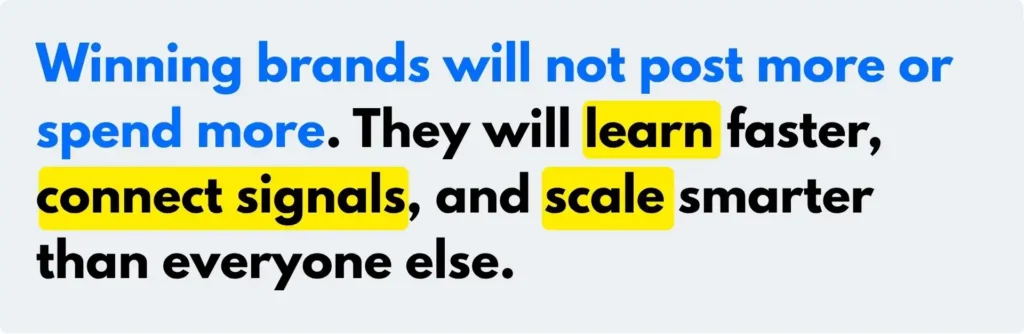
The brands that will win in the next few years will not win because they posted the most or spent the most.
They will win because they learned the fastest and built systems that connect everything.
The social media landscape is noisier than ever. Getting attention is harder. Keeping it is harder. Converting it is harder. But the brands that treat every post as a data point, every campaign as a learning opportunity, and every insight as fuel for what comes next will keep pulling ahead.
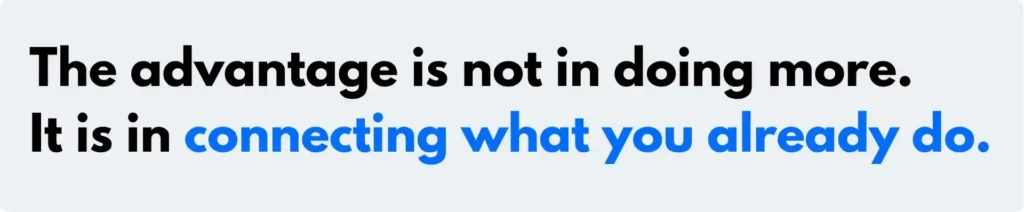
It is not about doing more. It is about doing things that are connected to each other and pointed in the same direction.
Bringing It All Together
Social media management keeps you visible. It builds the familiarity and trust that makes people feel comfortable with your brand.
Social media marketing drives growth. It takes that trust and turns it into real business results.
But neither one works fully on its own. Management without marketing keeps you stuck in maintenance mode. Marketing without management keeps you reaching people who do not trust you yet.
The real advantage is in connecting them. Letting what you learn from daily content shape your campaigns. Letting your campaign results influence your content. Building a system where every part of your social media effort is talking to the other parts.
Most brands are not doing this. Most brands are treating content and growth as separate problems. And that gap is exactly where they are losing.
Stop treating them as two different jobs. Start building the system that connects them.
Run a Bluekona audit and see what your content is really telling you about what drives your growth.