

How to Know What Content to Repurpose And What to Retire
You’ve probably published hundreds of blog posts, landing pages, social content, and resource guides over the years. But be honest — how many of those assets are still driving meaningful results today?
If you’re like most marketing teams, the answer is “very few”.
Research shows that more than 60% of published content generates little to no organic traffic after just six months. That means the bulk of your hard work is quietly rotting away — outdated, ignored, and invisible in search.
Yet within that giant content graveyard, there are often hidden pages with proven audience interest, or past traffic that just needs a boost.
The real challenge is knowing what deserves a second chance, and what should be put out of its misery for good.
In this post, I’ll break down a simple, repeatable content repurposing strategy that helps you
- Pinpoint high-potential content worth reviving
- Spot obsolete pieces you can safely retire
- Streamline the entire process with AI-powered content audit tools that take the guesswork out of prioritization
You’ll get a clear, tactical framework and see exactly how to apply it using an automated content lifecycle management approach.
Let’s transform your bloated content library into a lean, ROI-generating machine.
Why Some Content Deserves a Second Life?
Not every piece of underperforming content should be tossed in the trash. In fact, some of your best growth opportunities may come from evergreen topics that have simply decayed over time.
Think of it like a house with solid foundations but peeling paint. The core idea is still valuable — it just needs a refresh.
Here’s why giving existing content a second life is such a smart move:
Evergreen + decaying content = low-hanging fruit
If you already covered an evergreen topic that once performed well, updating it is far easier (and faster) than creating something from scratch. You’ve got a head start with backlinks, a history of ranking keywords, and some brand familiarity.
Updating can outperform net-new creation
Many marketers think publishing more content is always the answer. But updated content often sees ranking improvements much faster than brand-new posts, thanks to Google’s preference for freshness. In fact, a well-optimized update can reclaim traffic and authority in weeks — while new content can take months to ramp up.
Repurposing helps you reach new audiences
You can breathe fresh life into proven ideas by reshaping them for different channels:
- Turn a top blog post into a short-form video
- Slice it into a LinkedIn carousel
- Summarize it for a Twitter thread
- Adapt it for a webinar or newsletter
That way, you’re maximizing every ounce of value from content you already know resonates — without reinventing the wheel.
Instead of burning resources on constantly reinventing the next “big post,” you’ll get far more leverage by systematically repurposing what’s already working.
How to Identify Content Worth Repurposing
So, how do you separate the content with real second-life potential from the pieces that should stay buried?
You don’t want to repurpose just any outdated post. You want to focus on assets with enough existing value that a strategic refresh can turn them into winners again.
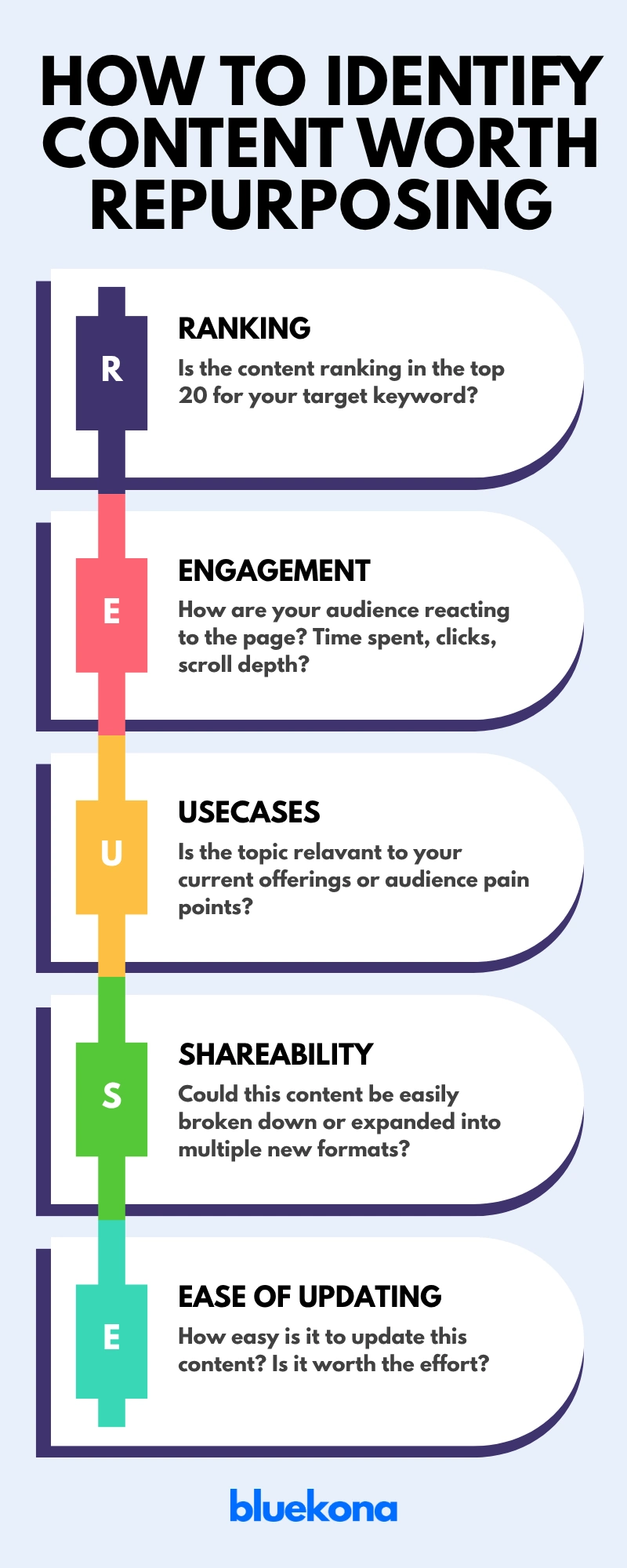
To make this process dead simple, use the REUSE Score — a five-part framework that helps you instantly evaluate whether a piece of content is worth repurposing.
R — Rankings
- Is the content ranking in the top 20 for any target keyword?
- Even if it’s on page 2 of Google, that’s a sign it has ranking potential worth reviving.
E — Engagement
- Does it have decent time on page, comments, or social shares?
- Good engagement signals mean your audience already found it valuable once — a perfect candidate to repackage or update.
U — Use Cases
- Is the topic still relevant to your business today?
- Does it align with your current offerings or audience pain points?
- If yes, repurposing makes sense. If no, consider retiring it.
S — Shareability
- Could this content be easily broken down or expanded into multiple new formats?
- Social posts
- Short-form videos
- Infographics
- Podcasts
- If yes, you’ll get more ROI from repurposing.
E — Ease of Updating
- Can you modernize it quickly with fresh data, visuals, or a minor rewrite?
- Or does it need a complete overhaul?
- Easy wins should go straight to the top of your repurposing list.
By applying the REUSE Score, you’ll never again waste time guessing which pieces deserve a second life. You’ll have a simple, repeatable way to prioritize high-ROI repurposing opportunities.
How to Spot Content That Needs to Be Retired
Not every piece of old content deserves a second chance. Some posts are simply beyond rescue — and keeping them live might actually hurt your site’s performance by wasting crawl budget, confusing search engines, or cannibalizing your rankings.
Here’s how to know when to retire content, confidently and guilt-free.
Outdated Stats or Irrelevant Topics
- If the post covers data from five years ago, or trends that no longer exist, it’s a poor fit for today’s audience.
- If the topic is no longer relevant to your current brand or offering, let it go.
Zero Traffic for 12+ Months
- Check Google Search Console and Google Analytics:
- Has the post delivered no meaningful organic or referral traffic for a year or more?
- If so, it’s usually dead weight.
Competing (Cannibalizing) Pages
- Sometimes multiple pages target the same keyword and end up fighting each other in Google.
- Look in Search Console:
- Do impressions and clicks seem split across similar pages?
- If yes, consider consolidating into one stronger post, and retire the duplicate.
Off-Brand or Legacy Campaigns
- Older content tied to discontinued products, seasonal campaigns, or outdated messaging can damage your brand if left online.
- Ask yourself: Would I feel proud to show this to a prospect today?
- If the answer is no, archive or redirect it.
Quick Metrics to Check Before Hitting Delete
In Google Search Console
- CTR steadily dropping over 6–12 months
- Impressions flatlined or trending to zero
- Position stuck outside the top 30
In Ahrefs or SEMrush
- Zero backlinks or lost all referring domains
- No keyword rankings in the top 50
- Traffic estimates = zero
When you see these patterns, don’t waste time trying to save that content. Retire it, redirect if necessary, and refocus your energy on assets with true repurposing potential.
Manual Audit? Painful. Here’s the AI Shortcut.
Let’s be honest, auditing hundreds of posts manually can be a nightmare. You’d have to pore over spreadsheets, cross-check traffic stats, analyze keyword cannibalization, check backlinks, and then figure out repurposing formats — one by one.
No wonder so many content teams procrastinate, or worse, keep guessing about what to update.
That’s exactly why we built Bluekona AI — to automate the entire repurposing audit process and help you reclaim more ROI from your content library in minutes, not weeks.
Here’s how it works
Auto-Detects High-Potential, Decaying Posts
Bluekona continuously scans your content inventory and spots pages showing organic traffic decay but with strong past performance signals — the perfect repurposing targets.
Pulls Performance Data from Every Platform
Instead of you jumping between Google Analytics, Search Console, Ahrefs, or social metrics, Bluekona ingests them all automatically. You get a unified dashboard showing exactly which posts are underperforming, and why.
Suggests the Best Repurposing Format
Should you turn that stale blog post into a LinkedIn carousel? A short-form video? A tweet thread? Bluekona analyzes engagement patterns to recommend the right format to breathe new life into your existing content.
Flags Irrelevant or Obsolete Posts to Archive
No more guessing which posts to kill off. Bluekona flags content with zero relevance, outdated messaging, or keyword cannibalization, so you can retire it confidently and keep your content library lean and high-performing.
Stop Guessing. Start Repurposing With Purpose.
Your content library is a goldmine — but only if you know how to separate the hidden gems from the dead weight.
Most brands waste hundreds of dollars creating new content while ignoring existing assets that could be updated and repurposed to drive 2–3x more results, with a fraction of the effort.
By applying a systematic, data-backed framework like the REUSE Score — and leveraging AI to automate the heavy lifting — you’ll never have to second-guess what to revive, what to retire, or how to prioritize.
It’s time to transform your content operations from a guessing game into a precision growth engine.
Let Bluekona AI audit your content library and show you the high-ROI opportunities in minutes — so you can repurpose with purpose, and win back your valuable time.