
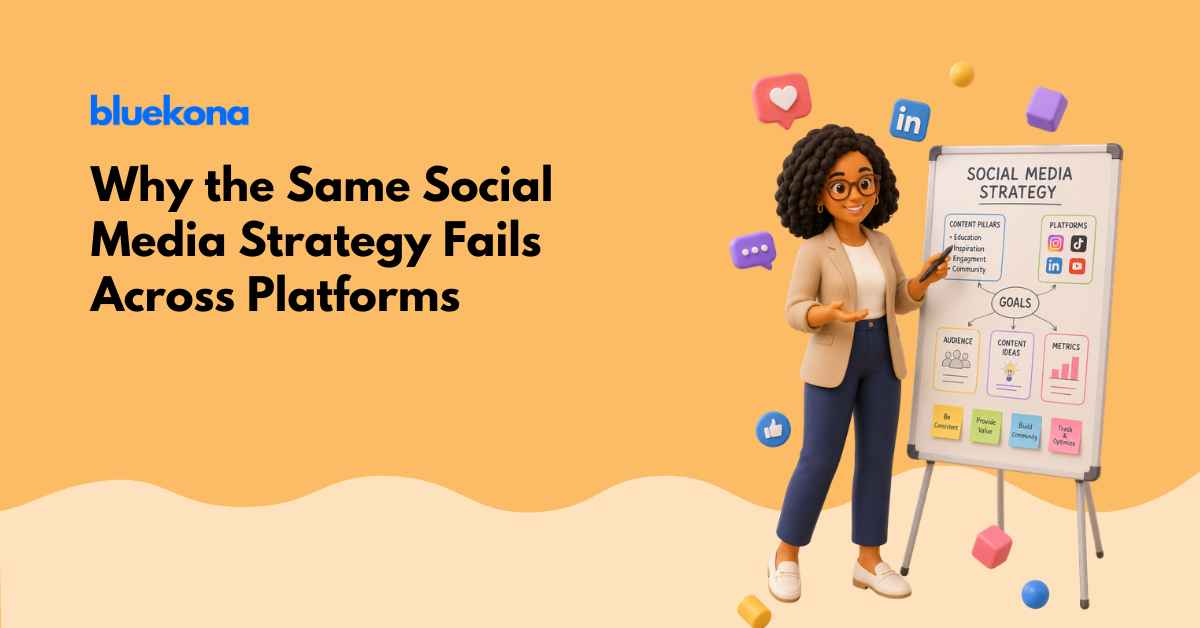
Why the Same Social Media Strategy Fails Across Platforms
Most brands do not actually have a content problem. What they have is a mismatch problem. The same post goes out on LinkedIn, Instagram, TikTok, Facebook and YouTube, all on the same day, all looking the same. Then everyone sits around wondering why one platform brings results and the rest bring silence.
Here is the simple truth. Different people use different platforms for different reasons. A teenager scrolling TikTok on a Tuesday night is not in the same headspace as a manager researching software on YouTube during lunch. A founder checking LinkedIn before a meeting is not doing the same thing as a parent chatting in a Facebook group about weekend plans.
People do not log into platforms. They log into moods. Forget that and your content just becomes background noise.
Delphi the Dolphin
This guide walks through how audience, platform, content and business goals fit together, and how Bluekona helps you figure out what is actually working instead of guessing.
The Biggest Social Media Mistake Brands Still Make
A lot of companies treat social media like a broadcast tower. One piece of content goes up, then it gets copied and pasted across five platforms with zero changes. Same caption, same image, same tone, everywhere.
The problem is that social platforms are not the same kind of place. They are not five doors leading into the same room. Each one is its own little world, with its own rules, its own pace and its own kind of audience attention. When you post the exact same thing everywhere, you are speaking the same language to people who are not listening for the same things.
Think about how differently you behave on different apps. On LinkedIn you might be reading something useful before a meeting. On Instagram you might be looking for something nice to look at while waiting in line. On TikTok you might just want to laugh for thirty seconds. None of these moods match up, so why would one piece of content work for all of them?
Different Platforms, Different Mindsets
People do not just use platforms, they use them with a purpose in mind, even if that purpose is something small like killing five minutes. Once you understand what mindset someone is in when they open an app, it becomes much easier to know what kind of content will actually land.
On LinkedIn, people are usually thinking about their work, their career or their industry. They are reading with a slightly more serious hat on. This is the place for thought leadership, industry insights, case studies and the occasional opinion that goes against the usual advice. People here want to learn something or feel sharper after reading.
Instagram is more about feeling than thinking. People come here for inspiration, for lifestyle, for a sense of who they want to be. Reels, visual storytelling, behind the scenes glimpses and creator collaborations all do well here because they tap into identity and aspiration rather than logic.
TikTok
TikTok is built for discovery and entertainment. People are not searching for anything specific, they are just scrolling and letting the app surprise them. Short videos, trends, things that feel real and unpolished, and quick product demos all fit this fast moving environment.
Facebook still has a strong sense of community and family around it. A lot of activity happens in groups, in local discussions and around small businesses. Customer stories and community conversations do well here because people are looking for connection, not just content.
YouTube
YouTube is where people go when they actually want to solve something. They are researching, learning or trying to decide between two options. Tutorials, comparisons, reviews and deep dives work well because the audience has already arrived with a question in mind.
Understanding Generational Behavior
On top of platform behavior, there is also the question of who you are talking to in terms of age and life stage. Different generations were raised on different internet habits, and that shapes what feels natural to them.
Gen Z
Gen Z grew up with social media as their default search engine. Around 46 percent of them say they prefer social platforms over traditional search when looking things up, and about 77 percent use TikTok to discover new products. Many of them spend more than four hours a day on social apps.
What they respond to is authenticity, community, fast answers and entertainment. Brands that want their attention need to lean into short form video, work with creators, use content made by real users, and build things that feel interactive rather than one way.
Millennials
Millennials are big users of social media too, with around 86 percent active on these platforms and an average of 8.4 accounts per person. About 56 percent say they buy things based on influencer recommendations, and 65 percent trust suggestions that come from friends.
This group wants practical value. They want to trust the brand, they want convenience, and they want to feel like the people behind the brand know what they are talking about. Educational content, honest testimonials, real case studies and influencer partnerships all work well here.
Gen X and Boomers
These audiences value trust, familiarity, simplicity and reliability above almost everything else. They are not chasing trends, they are looking for something steady. Community focused content, regular engagement on Facebook, longer educational videos and genuine customer success stories tend to do well with this group.
The Apollo.io Playbook
For sales reps and founders, Apollo focuses on LinkedIn, TikTok and YouTube Shorts, with content built around growth hacks, tutorials and practical workflows people can use right away. For VPs of sales and other executives, the focus shifts to LinkedIn, review sites and more enterprise focused channels, with messaging centered on return on investment, consolidating tools and overall business outcomes.
The product is the same. What changes is who is being spoken to, where they are being reached, and what kind of message actually matters to them.
Same product, different hats. A founder wants a quick win. A VP wants a reason to sleep at night. Talk to both, just not with the same sentence.
Delphi the Dolphin
Why Posting Frequency Is Not the Real Problem
A question that comes up again and again is how often a brand should be posting. Should it be daily, three times a week, once a day per platform?
The honest answer is that frequency is the wrong starting point. The better question is what should be posted, where it should go, and who it is actually for. Posting seven times a week to an audience that does not care will almost always do worse than posting three times a week to people who are genuinely interested.
Frequency still matters, but only after relevance, audience fit and content quality are in place. Without those, more posting just means more noise.
Building an Audience-Platform Matrix
One simple way to bring all of this together is to build a kind of matrix or map that connects audience to platform to content to goal. It does not need to be complicated, but it does need to be honest.
Start by asking who your audience actually is. Are they Gen Z, Millennials, Gen X, professionals, everyday consumers, or decision makers inside companies?
Next, ask where these people actually spend their time. Not where you assume they spend time, but where they really are based on what you can see in your own data.
Then look at what kind of content they consume in those spaces. Are they watching videos, scrolling carousels, reading thought leadership posts, following tutorials, or hanging out in community groups?
Finally, be clear about what action you actually want. Is this about awareness, engagement, getting leads, driving sales, or keeping existing customers around longer? Each of these goals might point you toward a different mix of platform and content.
Why Most Brands Struggle
Most brands are not failing because they are lazy. They are failing because they are working off assumptions instead of evidence.
You hear things like, we should be on TikTok because everyone is talking about it, or LinkedIn is hot right now so let us double down there, or let us just post every single day and see what happens. None of these statements actually answer the real questions. Is our audience even there? Are they engaging when we show up? What kind of content is actually working for us right now?
Without answers to those questions, a strategy is really just a guess dressed up as a plan.
How Bluekona Helps
This is exactly where Bluekona comes in, by turning those guesses into something you can actually see and act on.
On the audience side, Bluekona helps you understand who is engaging with your content, what kind of content resonates with them, and how different audience segments are responding over time.
On the platform side, it shows you where your engagement is actually strongest, how each platform is performing compared to the others, and how content effectiveness differs from one channel to the next.
On the content side, it helps identify which content pillars are winning, what your audience seems to genuinely prefer, and what patterns keep showing up in the way people engage.
Put together, this means that instead of guessing where to post, how often to post, or what to create next, you get a clearer, data backed direction to work from.
“I am not here to tell you social media is hard. I am here to tell you that guessing is hard. The data was just sitting there the whole time.” – Delphi
The Future of Social Media Strategy
The brands that win going forward will be the ones that stop thinking platform first and start thinking audience first. Instead of asking which app to chase next, they will ask who they are actually trying to reach, what those people care about, where they spend their time, and how they like to take in information.
Once those questions are answered honestly, the platform strategy almost builds itself. The platforms are just the rooms. The real work is understanding the people inside them, and that is the shift that separates brands that get noticed from brands that get scrolled past.
Frequently Asked Questions
Does every business need to be on every social media platform?
No. It makes more sense to focus on the platforms where your target audience is actually active and engaged, rather than trying to be everywhere at once.
How do I know which platform is best for my audience?
Look at audience demographics, content preferences and engagement patterns instead of just following whatever platform is trending at the moment.
Is posting more often always better?
Not really. Consistent, good quality content aimed at the right audience usually does better than high volume posting aimed at nobody in particular.
Should B2B and B2C brands use different social media strategies?
Yes. While some basic principles overlap, audience behavior, content formats and buying journeys tend to look quite different between the two.
How can Bluekona improve audience targeting?
Bluekona helps identify audience segments, content performance patterns and platform specific opportunities using real engagement and behavioral data, so decisions are based on what is actually happening rather than assumptions.